
Introduction
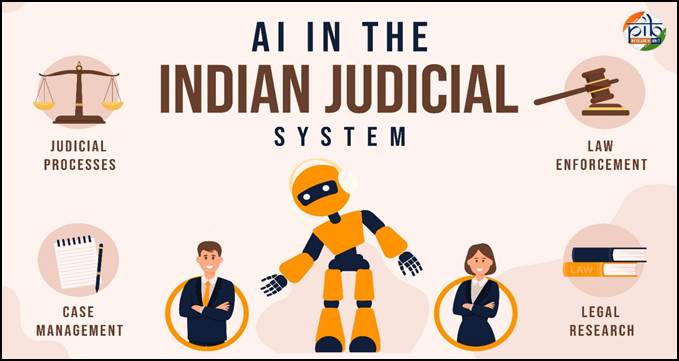
The Indian judicial system is one of the largest in the world, handling millions of cases annually. With more than 4.5 crore pending cases across various courts, ensuring timely and efficient justice delivery has become an enormous challenge. In recent years, Artificial Intelligence (AI) has emerged as a powerful tool with the potential to transform judicial functioning. Courts are experimenting with AI for tasks such as legal research, translation, transcription, case management, and even predictive analytics.
However, the integration of AI into the justice system raises significant legal, ethical, and constitutional questions. Concerns about transparency, accountability, and the possibility of algorithmic bias compel us to consider whether India is ready for this technological revolution. This article explores how AI is being used in Indian courts, the advantages and risks of such use, and the urgent need for a strong regulatory framework.
AI in the Indian Judiciary: Current Developments
1. SUPACE (Supreme Court Portal for Assistance in Courts Efficiency)
Launched in 2021, SUPACE is an AI-driven tool designed to assist judges with legal research. It automates tasks such as extracting case facts, summarizing documents, and identifying relevant precedents. The system does not make decisions; instead, it supports judges by reducing time spent on repetitive manual tasks.
2. SUVAS (Supreme Court Vidhik Anuvaad Software)
This AI-based translation tool converts judicial documents into multiple Indian languages. Given the linguistic diversity of litigants, SUVAS has helped improve accessibility and reduce dependency on translators.
3. Digitization and Virtual Courts
During the COVID-19 pandemic, courts across India adopted e-filings, online hearings, and digital documentation. AI tools for transcription, scheduling, and document organization are increasingly used to support these processes.
4. High Court Innovations
Several High Courts, including Kerala, Delhi, and Karnataka, have experimented with AI-based transcription services and legal research assistants.
These developments mark the beginning of a new era in India’s judicial system, but they also highlight the need for a deeper conversation about AI’s long-term impact.
Opportunities Presented by AI in the Legal System
1. Faster Case Processing
AI can significantly reduce the time spent on administrative tasks such as:
- Sorting documents
- Summarizing case files
- Identifying conflicting precedents
- Scheduling hearings
This enables judges and lawyers to devote more time to legal analysis and decision-making.
2. Reduction in Backlogs
By improving efficiency, AI tools can play a role in reducing India’s overwhelming backlog of cases.
3. Improved Access to Justice
AI-based translation tools make court documents comprehensible to litigants in their own language. Chatbots can assist individuals in drafting applications or understanding basic legal rights.
4. Consistency in Judgments
AI tools can identify patterns and past decisions, enabling more consistent application of the law. This can help reduce disparities in sentencing and judicial interpretation.
5. Enhancing Transparency
AI can help track case progress, generate reports, and identify administrative bottlenecks, promoting transparency and accountability.
Risks and Concerns Associated with AI in the Judiciary
Despite its benefits, the use of AI in the judiciary raises serious legal and ethical concerns.
1. Algorithmic Bias
AI systems learn from historical data. If past judgments contain systemic bias, the AI tool may replicate or reinforce such biases. This can disproportionately affect vulnerable groups, including minorities, women, and economically disadvantaged communities.
2. Threat to Judicial Independence
If AI tools go beyond administrative assistance and begin influencing judicial decision-making, it may undermine the independence and discretion of judges.
3. Lack of Transparency and Accountability
Most AI systems operate as “black boxes,” making it difficult to understand how they reach conclusions. This lack of explainability conflicts with core principles of natural justice, especially the right to reasoned judgment.
4. Privacy and Data Protection Issues
AI tools require large volumes of legal data, much of which may contain sensitive personal information. Without strong data-protection laws, such information may be misused or inadequately secured.
5. Digital Divide
Many litigants and lawyers still struggle with basic digital tools. If AI becomes central to court functioning, those without digital literacy may face new barriers to justice.
Constitutional Considerations
1. Right to Equality (Article 14)
AI-based tools must not discriminate. Any algorithmic bias would violate the constitutional guarantee of equality before the law.
2. Right to Life and Personal Liberty (Article 21)
Article 21 includes the right to fair trial and privacy. Unregulated AI may threaten both these rights if used without safeguards.
3. Separation of Powers
AI should assist the judiciary, not replace or influence judicial reasoning. Excessive reliance may raise questions under the doctrine of separation of powers.
The Need for a Robust Legal Framework
AI is advancing faster than the legal system can regulate it. India urgently needs a clear policy framework covering:
1. Guidelines for AI Use in Courts
The judiciary must establish boundaries defining what AI can and cannot do, ensuring that decision-making remains human-driven.
2. Mandatory Human Oversight
AI tools should only assist judges; human oversight must be mandatory in all judicial decisions.
3. Transparency Requirements
AI systems used in courts should be explainable, with clear documentation about how they process data and generate outputs.
4. Data Protection Laws
India’s data protection framework must include special provisions for judicial data, including encryption, consent, and secure storage requirements.
5. Bias Audits and Regular Assessments
AI tools must undergo periodic audits to detect algorithmic bias, inaccuracies, or misuse.
6. Training for Judges and Lawyers
Capacity building is essential to ensure judicial officers and advocates understand how to use AI tools responsibly.
Finding a Balanced Approach
AI has the potential to revolutionize India’s judicial system, but it must be used responsibly. A balanced approach should include:
- Judges using AI as a research assistant, not a decision-maker
- Strict privacy protection for litigants
- An ethical framework to prevent discrimination
- Transparent and accountable AI models
- Public awareness and digital literacy programmes
The goal should not be to replace human judgment but to enhance it.
Conclusion
The introduction of Artificial Intelligence in Indian courts represents a major milestone in the evolution of the justice system. Done correctly, AI can reduce delays, increase efficiency, and make justice more accessible. However, without clear guidelines and strong legal protections, AI may create new forms of inequality, compromise privacy, and threaten the integrity of judicial decision-making.
India now stands at a crossroads. The question is not whether AI should be used in the judiciary, but how. A robust legal framework—based on transparency, accountability, and constitutional values—is essential to ensure that technology strengthens justice rather than undermining it. As we move deeper into the digital age, the Indian legal system must adapt, innovate, and uphold its fundamental commitment: justice for all.
Contributed by: Lalit (Intern)