
BACKGROUND & GENESIS OF THE CASE
The matter arose from an incident at the Odhav Police Station, Ahmedabad, Gujarat, where an FIR was registered under various provisions of the BNSS read with the Gujarat Money-Lenders Act, 2011 and the SC/ST (Prevention of Atrocities) Act, 1989. After the accused secured bail through a regular bail application argued before the Sessions Judge, the Investigating Officer issued a notice under Section 179 of the BNSS directing the bail-arguing advocate to appear and disclose the “true details of the facts and circumstances” of the case.
When the advocate approached the High Court, relief was refused on the ground that the advocate had not cooperated with the summons, thereby stalling the investigation. The Supreme Court, taking suo motu cognizance alongside connected petitions, framed two questions of “utmost public importance”:
- whether an investigating agency can directly summon an advocate appearing for a party, and
- whether judicial oversight should be mandated before any exception to privilege is invoked.
THE LEGAL FRAMEWORK: SECTION 132, BSA 2023
“An Advocate cannot be coerced into revealing any information with respect to the client he represents… which would be in violation of Section 132.”
Section 132 of the Bharatiya Sakshya Adhiniyam, 2023 — which is in pari materia with Section 126 of the Indian Evidence Act, 1872 — prohibits an advocate from disclosing any communication made to him in the course of his professional engagement without the client’s express consent. The privilege, the Court emphasised, is a protection conferred on the client, though it creates a corresponding immunity on the advocate against being compelled to disclose.
The exceptions carved in the proviso are narrow:
- communication in furtherance of an illegal purpose, and
- facts observed by the advocate revealing that a crime or fraud was committed after the commencement of his engagement.
Critically, the Court reiterated that the illustrations appended to Section 132 are indicative and that an advocate’s disclosure of privileged matters — even if compelled by an IO — would constitute professional misconduct, rendering the information inadmissible against the client.
WHY NO GUIDELINES WERE FRAMED
The Bar Associations urged the Court to invoke Article 142 powers, analogous to the guidelines in Jacob Mathew v. State of Punjab (2005) 6 SCC 1 (medical negligence) and Vishaka v. State of Rajasthan AIR 1997 SC 3011 (sexual harassment at workplaces). The Court declined, sharply distinguishing both precedents. Jacob Mathew addressed criminal liability arising from professional negligence — a domain where the IO lacks domain expertise. Here, an IO is presumed to know the law, including Section 132. Vishaka addressed a legislative vacuum; no such vacuum exists when Sections 132–134 of the BSA explicitly govern the field.
The Court also rejected the proposal for a peer-review committee of legal professionals or mandatory prior magisterial approval. Routing every summons through such a mechanism would, the Court reasoned, be counter-productive and potentially frustrate legitimate investigation. More importantly, any committee decision taken in the absence of the client — the very person whose privilege is at stake — would run “counter to the basic tenets of full and effective legal representation.”
CONSTITUTIONAL DIMENSIONS
The judgment fortifies the right to legal representation as a constitutional guarantee. Drawing from M.H. Hoskot v. State of Maharashtra (1978) 3 SCC 544 and Articles 21, 22(1), and 39-A, the Court held that summoning a defending advocate to speak about the very case he is defending directly imperils the accused’s constitutional rights — including the protection against self-incrimination under Article 20(3). A client cannot be placed in a worse position merely because he confided in his advocate than if he had remained entirely silent. As the Court put it, a person cannot “walk out of his counsel’s office with a defaced privilege” he entered with intact.
THE IN-HOUSE COUNSEL QUESTION
Addressing an intervention by the General Counsels Association of India, the Court held that in-house counsels — being full-time salaried employees — fall outside the definition of “Advocate” under the Advocates Act, 1961, read with Rule 49 of the Bar Council of India Rules. Relying on the Constitution Bench decision in Rejanish K.V. v. K. Deepa (2025 SCC OnLine SC 2196) and the European Court of Justice’s ruling in Akzo Noble Limited v. European Commission, the Court held that independence from the employer is foundational to privilege. An in-house counsel, constrained by commercial and employment ties, cannot claim the same professional independence as an external advocate. Accordingly, in-house counsels are not entitled to the privilege under Section 132, though limited protection under Section 134 remains available for communications with an employer’s legal advisor.
DOCUMENTS AND DIGITAL DEVICES
On the ancillary question of documents and digital equipment, the Court drew a distinction: production of documents is not protected by privilege under Section 132 (following Gangaram v. Habib-Ullah, 1935), and the IO may direct production under Section 94 of the BNSS, but only before a Court — not before the officer himself. Where a digital device is produced, the Court mandated that it be opened only in the presence of the advocate, the client, and a person with expertise in digital technology of their choice, and that examination be confined strictly to the material sought by the IO, safeguarding confidential data of other clients.
KEY DIRECTIONS ISSUED
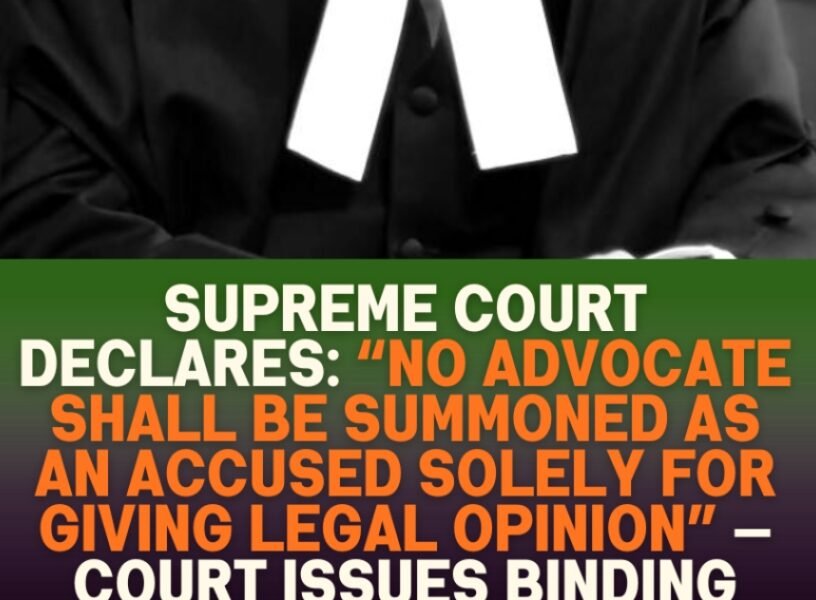
- No direct summons: IOs cannot summon an advocate appearing in a case to elicit case details unless the summons specially falls under secion 132 exception.
- Prior superior approval: an such summons must bear the written satisfaction of an officr nor below the rank of superintendent of police recording the applicable exception.
- Judicial review available: A summons so issued is subject to challenge under section 528 BNSS before the High court.
- Privilege extends beyond litigation: The privilege covers advocates engaged in non-litigious. Pre-litigation; or advisory capacities including retainerships.
- Digital devices: Production directed to Court only; examination in presence of advocate, client, and a digital expert of their choice.
- In-house counsel: Not entitled to Section 132 privilege; limited protection under Section 134 only.
CONCLUSION: PRIVILEGE AS A PILLAR OF THE RULE OF LAW
Borrowing from Chief Justice John Marshall’s maxim that “the power to tax is the power to destroy,” the Court drew a compelling corollary: the power to summon under Sections 175 and 179 of the BNSS is not the power to interfere with privileged attorney-client communications — at least “as long as the Constitutional Courts sit in this country.” The summons issued in the triggering case was quashed as illegal. The High Court’s refusal to interfere was expressly condemned as an “abdication of inherent powers.”
The ruling is significant for several reasons. It affirms that attorney-client privilege in India is not a mere evidentiary rule but a principle with constitutional moorings rooted in Articles 20(3), 21, and 22(1). It cautions that investigative overreach — whether born of “deliberate design or abject ignorance” — will not be excused. And it places the constitutional courts as the final bulwark against such encroachments, rendering any summons to an advocate judicially reviewable on its face for compliance with Section 132.
For the practising bar, this judgment offers substantial relief: the privilege is robust, the exceptions are narrow, and no disclosure compelled in violation of Section 132 can be used against the client. The independence of the legal profession — described by the Court as indispensable to the administration of justice and the preservation of liberty — has been reaffirmed with the full authority of the Supreme Court of India.
Contributed by Advocate Vinay Kumar