
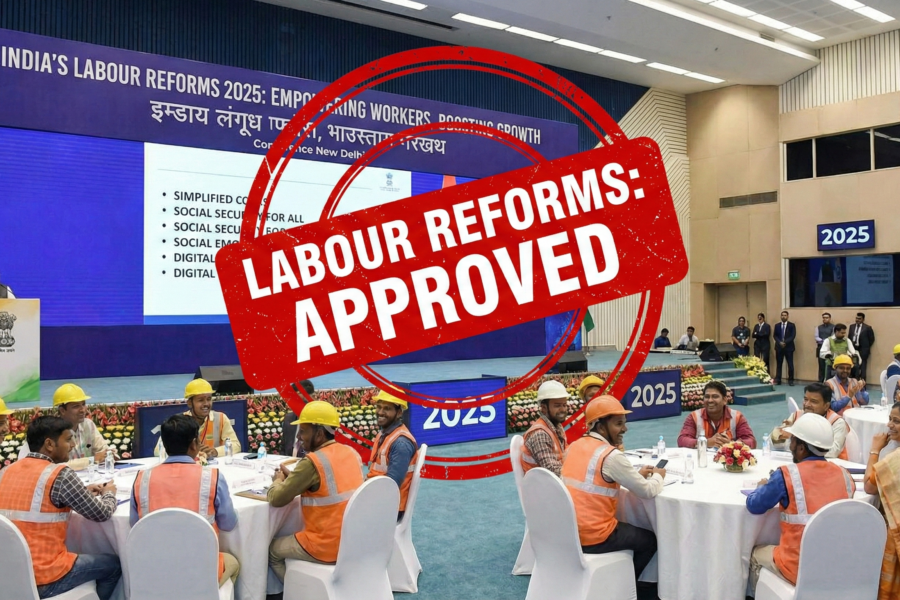
India’s Labour Reforms 2025: Rewriting the Legal Architecture
Introduction: A Structural Reset of Indian Labour Law
India’s labour law framework underwent a historic and long-anticipated transformation with the enforcement of the Four Labour Codes on 21 November 2025. This development marked the culmination of a reform agenda that had been debated, drafted, and contested for more than a decade. The primary objective of this overhaul was to modernise a labour law regime that was largely rooted in colonial-era statutes, many of which had become ill-suited to contemporary economic realities and employment practices. The reforms were also designed to reduce regulatory fragmentation, streamline compliance obligations, and respond to the emergence of new forms of work, particularly gig, platform, and fixed-term employment.
By consolidating 29 central labour enactments into four comprehensive codes, the legislature sought to create a simplified yet robust legal framework capable of balancing economic growth with worker protection. The Four Labour Codes aim to promote formalisation of employment, enhance social security coverage, and reduce transaction costs for enterprises, while retaining core labour welfare principles. At the same time, the reforms signal a policy shift towards flexibility, efficiency, and digital governance.
Nevertheless, the implementation of the Labour Codes has been accompanied by significant controversy. Trade unions, opposition parties, and labour scholars have expressed concerns regarding the potential dilution of job security, weakening of collective bargaining mechanisms, and uneven implementation across states. These concerns raise critical questions regarding federal coordination, constitutional safeguards, and the long-term impact of the reforms on labour rights. As India transitions into this new legal regime, the Labour Codes invite close scrutiny from courts, policymakers, and stakeholders alike. This article examines the rationale behind the reforms, the substantive changes introduced by each Code, and the legal and constitutional challenges that lie ahead.
The Rationale Behind Labour Law Consolidation
Prior to 2025, India’s labour governance framework was characterised by legislative multiplicity and regulatory inconsistency. The existence of 29 central labour laws, supplemented by hundreds of state-specific rules, created a complex and often contradictory compliance environment. Employers were required to navigate overlapping definitions, multiple registrations, and divergent reporting requirements, resulting in high compliance costs and frequent litigation. For workers, particularly those in the informal and unorganised sectors, this fragmented regime failed to deliver effective protection or access to social security benefits.
Enforcement mechanisms under the earlier framework were often discretionary, contributing to concerns surrounding “inspector raj”, rent-seeking behaviour, and selective enforcement. The lack of uniformity in application further discouraged enterprises from formalising employment relationships. As a result, nearly 90 percent of India’s workforce continued to operate outside formal employment structures, undermining the objectives of labour welfare legislation and social security schemes.
The case for consolidation gained institutional backing through the recommendations of the Second National Commission on Labour, which advocated for the simplification and harmonisation of labour laws to improve compliance and coverage. These recommendations were subsequently reinforced by India’s commitments under global ease-of-doing-business indices, which emphasised regulatory certainty and simplification. The economic disruptions caused by the COVID-19 pandemic further highlighted the vulnerabilities of informal employment, particularly for migrant workers who lacked access to portable social security benefits.
Against this backdrop, Parliament enacted the four Labour Codes between 2019 and 2020 with the intention of creating a unified, technology-enabled framework. The delayed enforcement of the Codes until November 2025 reflects both the political sensitivity surrounding labour reform and the federal complexity arising from labour being a subject under the Concurrent List of the Constitution. The staggered and negotiated rollout underscores the challenges inherent in balancing economic reform with social consensus.
The Code on Wages and Industrial Relations: Flexibility Meets Regulation
The Code on Wages, 2019 establishes a uniform legal foundation for wage regulation across all sectors and categories of employment. By subsuming four existing statutes, the Code introduces a standardised definition of “wages” applicable for the purposes of minimum wages, payment of wages, bonuses, and equal remuneration. The imposition of a cap on wage exclusions at 50 percent of total remuneration is particularly significant, as it curtails the practice of artificially structuring salary components to reduce statutory contributions. This provision has direct implications for provident fund liabilities, gratuity calculations, and payroll structuring.
The Code also empowers the Central Government to fix a national floor wage, which serves as a benchmark below which state governments cannot prescribe minimum wages. In addition, it reinforces the principle of equal remuneration for work of equal value and explicitly prohibits discrimination on grounds of gender, caste, religion, or other protected identities. By extending coverage to all employees irrespective of wage thresholds, the Code seeks to enhance inclusivity and ensure baseline wage protection across the workforce.
Complementing wage reform, the Industrial Relations Code, 2020 restructures the legal architecture governing trade unions, industrial disputes, and workforce restructuring. One of its most debated provisions is the increase in the threshold requiring prior government approval for layoffs, retrenchments, and closures from 100 to 300 workers. While this amendment is intended to incentivise industrial expansion and reduce operational rigidity, critics argue that it significantly weakens job security and bargaining power for workers in medium-sized establishments.
The Code also introduces fixed-term employment as a statutory category, granting such employees parity of wages and benefits with permanent workers, including gratuity on a pro-rata basis. Further, it mandates the constitution of grievance redressal committees and rationalises the adjudicatory framework by streamlining industrial tribunals. Collectively, these measures reflect a deliberate policy shift towards labour market flexibility, even as they intensify concerns among trade unions regarding erosion of collective rights.
Social Security Expansion and Workplace Safety Reform
The Code on Social Security, 2020 represents the most expansive attempt to extend welfare coverage within Indian labour law. For the first time, gig workers, platform workers, and unorganised workers are statutorily recognised as beneficiaries of social security schemes. This recognition reflects a significant departure from traditional employer-employee paradigms and acknowledges the changing nature of work in the digital economy.
Under the Code, aggregators are required to contribute a specified percentage of their annual turnover towards social security funds, marking a paradigm shift in the allocation of welfare responsibility. Fixed-term employees are granted eligibility for gratuity on a pro-rata basis, while provisions for universal account numbers and digital registration aim to ensure portability of benefits, particularly for migrant workers. These mechanisms seek to address long-standing gaps in coverage and continuity of social security entitlements.
In parallel, the Occupational Safety, Health and Working Conditions Code, 2020 consolidates safety and welfare regulations applicable to factories, mines, construction sites, and other establishments. The Code replaces rigid, prescriptive compliance norms with a facilitator-based enforcement model that emphasises self-certification, digital record-keeping, and risk-based inspections. This shift is intended to reduce bureaucratic interference while enhancing accountability.
Notably, the Code permits women to work night shifts subject to consent and prescribed safeguards, reflecting a progressive recalibration of workplace norms. At the same time, it imposes stringent obligations on employers with respect to safety standards, welfare facilities, and health monitoring. While the introduction of single registrations and licenses enhances operational flexibility, non-compliance attracts significant penalties, underscoring the Code’s emphasis on employer responsibility.
Federal and Constitutional Challenges
Despite their comprehensive scope, the Labour Codes face substantial implementation challenges arising from India’s federal structure. Labour being a subject in the Concurrent List, states are required to frame and notify their own rules to operationalise the Codes. As of December 2025, only a limited number of states have completed this process, resulting in regulatory asymmetry and compliance uncertainty, particularly for enterprises operating across multiple jurisdictions.
This uneven implementation risks undermining the objective of uniformity that underpinned the reform agenda. From a constitutional standpoint, the Codes may invite judicial scrutiny on grounds such as excessive delegation of legislative power, potential dilution of collective bargaining rights, and adequacy of social security protections for non-traditional workers. Courts may be required to reconcile economic policy considerations with fundamental rights under Articles 14, 19, and 21 of the Constitution.
Much like developments in environmental and insolvency law, labour jurisprudence is entering a phase where judicial interpretation will play a decisive role in shaping the practical contours of reform. The evolving case law will determine the balance between flexibility and protection within the new regime.
Compliance Imperatives for Employers and Enterprises
For employers, the Labour Reforms 2025 necessitate immediate and strategic compliance planning. Wage structures must be recalibrated to conform to the revised definition of wages, while employment contracts require updates to reflect fixed-term engagement norms and statutory benefits. Establishments are required to constitute grievance redressal committees, review contractor arrangements, and strengthen occupational safety systems in accordance with the new Codes.
Continuous monitoring of state-specific rules remains essential to ensure compliance and mitigate legal risk. From a risk management perspective, the transition period presents both opportunity and exposure. Organisations that proactively align internal policies with the new legal framework stand to benefit from reduced litigation and enhanced operational certainty. Conversely, delayed or partial compliance may result in penalties, employee disputes, and reputational harm. In this context, legal advisory support assumes critical importance.
Conclusion: A Reform That Will Be Defined by Implementation
India’s Labour Reforms 2025 represent a decisive attempt to modernise the legal foundations of work in a rapidly evolving economy. By consolidating fragmented laws, expanding social security coverage, and embracing digital governance, the Four Labour Codes seek to harmonise economic growth with social equity. Yet, their ultimate success will depend less on legislative ambition and more on effective implementation, cooperative federalism, and judicious constitutional interpretation.
As India progresses toward its long-term development objectives, labour law will remain central to both economic stability and social justice. For businesses, workers, and policymakers alike, the Labour Codes signify not the conclusion of reform, but the beginning of a dynamic legal evolution shaping the future of work in India.
Contributed By: Siddharth Bankal (Intern)