
INTRODUCTION
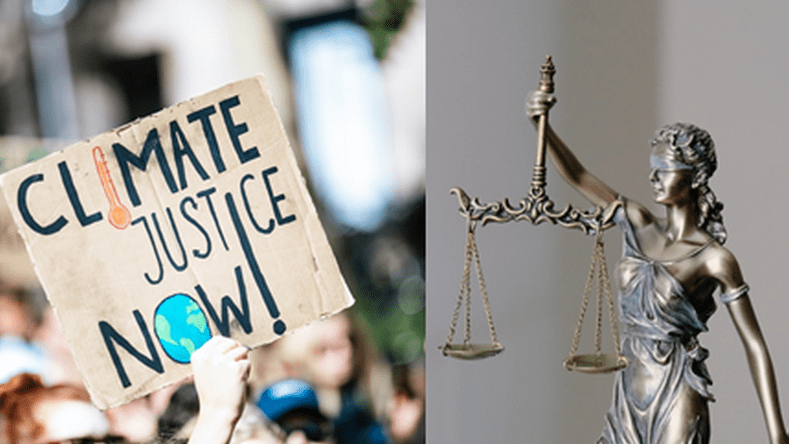
The legal doctrine of climate change litigation has quickly become one of the more vibrant and pivotal fields of modern popular concern and environmental law. With the heightened intensity of climate related catastrophes, such as extreme heat waves and floods, biodiversity loss and food insecurity, the world is turning to courts to decide whether State and non State actors can be legally held responsible to causing climate change or their inability to avoid foreseeable climate damage. What was a scientific, a political or a policy concern, has now squarely entered the legal arena, with some constitutional principles, human rights principles and state responsibility doctrines being involved.
This new branch of jurisprudence is indicative of a paradigm shift: climate change ceases to be an abstract future hazard, but a current-day legal ill, which has an impact on life, health, dignity, and environmental integrity. Climate litigation is hence a device of responsibility as well as an engine of more formidable climate regulation.
MEANING AND SCOPE OF CLIMATE CHANGE LITIGATION
Fundamentally, climate change litigation is judicial or quasi-judicial action whereby climate change is a central focus of the litigation. These proceedings may be initiated against governments, regulatory bodies, or other corporations, the activities or inactivities of which play a major role in greenhouse gas emissions or in eroding climate resilience. The extent of such litigation remains wide and it is ever-growing with the changing legal strategies.
Climate cases may broadly be categorised into:
- Mitigation cases, which challenge inadequate emission reduction targets or fossil fuel promotion;
- Adaptation cases, focusing on failure to protect vulnerable populations from climate impacts;
- Rights-based cases, where climate change is framed as a violation of fundamental or human rights; and
- Procedural cases, challenging flawed environmental impact assessments or decision-making processes.
At the domestic level, litigants often rely on constitutional provisions, environmental statutes, administrative law principles, and tort doctrines such as negligence or public nuisance. At the international level, climate litigation increasingly draws upon human rights treaties, customary international law, and principles such as intergenerational equity, the precautionary principle, and sustainable development.
STATE ACCOUNTABILITY IN CLIMATE LAW
One of the notable aspects of the modern climate litigation is the increasing tranche of State accountability. Courts are starting to recognize that governments have a legal obligation, not a moral or political obligation, to ensure that they are not harming the present and future generations as a result of climate.
- Human Rights Obligations
The connection of climatic change and human rights is one of the most important changes that have occurred in this field. Verein KlimaSeniorinnen Schweiz v. The European Court of Human Rights, Switzerland (2024) determined that the poor quality of climate mitigation by Switzerland was in breach of the European Convention on human rights (Article 8) which requires the right to respect to private and family life. The Court was aware of the reality and immediate dangers to the human well-being of climate change and the fact that States bear positive duties to take adequate climate policies.
The ruling was a landmark in the global jurisprudence because it stated that climate failure could be equivalent to human rights violation. It has reinforced legal basis of rights based climate claims across the world.
2. Constitutional Duties and Environmental Rights
In several jurisdictions, constitutional provisions have played a pivotal role in advancing climate accountability. Countries that recognise the right to a clean and healthy environment—either explicitly or through judicial interpretation—have seen courts enforce climate obligations on the State.
A notable example is Held v. State of Montana (2023), where youth plaintiffs successfully argued that the State’s promotion of fossil fuels without considering climate impacts violated their constitutional right to a “clean and healthful environment.” The court held that climate change posed a concrete threat to constitutional rights, particularly for younger and future generations.
Similarly, in India, the Supreme Court has repeatedly interpreted Article 21 (Right to Life) to include the right to a healthy environment, while Articles 48A and 51A(g) impose duties on the State and citizens to protect the environment. These provisions provide a strong constitutional basis for climate accountability, even though climate-specific litigation is still evolving.
3. Policy and Implementation Failures
The discrepancy between the government promises and the real action has also become the subject of climate litigation. In Urgenda Foundation v. The Dutch Supreme Court (Netherlands) directed the State to lower its greenhouse gas emissions by a minimum of 25 percent of the 1990 levels, and that the current government policies were inadequate in addressing subjects of duty of care towards its citizens.
Urgenda is important in that it dismisses the climate policy as a political issue. The court confirmed that governments are free to decide on the policy action but the court could assess whether the general degree of action complies with minimum legal standards of protection.
CHALLENGES IN CLIMATE CHANGE LITIGATION
Despite its growing success, climate litigation faces several doctrinal and practical challenges.
Attribution and Causation
One of the most complex issues is establishing causation. Climate change is a global phenomenon caused by cumulative emissions from multiple actors across borders. Proving that a specific State’s actions directly caused a particular harm can be legally challenging. However, courts have increasingly adopted a more flexible approach, recognising that partial contribution and increased risk can be sufficient to establish liability.
Justiciability and Separation of Powers
Courts are often reluctant to adjudicate climate cases on the ground that they involve policy decisions best left to the executive or legislature. This “political question” doctrine has been invoked to dismiss several climate claims. However, recent jurisprudence demonstrates a shift toward recognising that enforcing constitutional and human rights obligations falls squarely within the judicial function.
State Defences and Collective Responsibility
States frequently argue that climate change is a shared global problem and that unilateral action will have negligible impact. Courts, particularly in Uganda and Klima Seniorinnen, have rejected this defence, holding that the existence of a collective problem does not absolve individual States of their legal obligation
THE ARAVALLI DISPUTE: A DOMESTIC LENS ON ENVIRONMENTAL ACCOUNTABILITY
In 2025, the Supreme Court of India held that it would use a unified definition of the Aravalli Hills using a minimum height threshold provides a valuable domestic insight into how legal definitions can have a dramatic impact on environmental protection. The Aravallis is very instrumental in controlling climate, desertification and ecological flow in the northern part of India.
Opponents claim that elevation alone disqualifies lower-lying areas that are ecologically important in conservation thus allowing mining, construction, and deforestation. Although the conflict is not specified as climate litigation, it has apparent climate consequences, namely land degradation, regulation of heat, and loss of biodiversity.
From a legal perspective, the controversy raises important questions about State accountability under Articles 48A and 51A(g) of the Constitution. It also highlights the judiciary’s role in ensuring that environmental governance is informed by ecological science rather than narrow administrative convenience.
The Aravalli dispute underscores a crucial lesson for climate law: technical legal classifications and definitions can have profound consequences for climate resilience and environmental protection. Judicial oversight in such matters is therefore essential to prevent the dilution of constitutional environmental commitments.
CONCLUSION
Climate change litigation is reshaping the contours of public law by transforming climate inaction into a justiciable legal issue. Across jurisdictions, courts are increasingly willing to hold States accountable for failing to meet their climate obligations, whether grounded in human rights law, constitutional mandates, or principles of international law. Landmark decisions such as Uganda, Klima Seniorinnen, and Held demonstrate that climate governance is no longer immune from judicial scrutiny.
At the same time, domestic disputes like the Aravalli case remind us that climate accountability is not limited to emission targets or international agreements. It also depends on everyday legal decisions—definitions, classifications, and regulatory choices—that shape environmental outcomes on the ground.
Contributed by: Akash Singh