
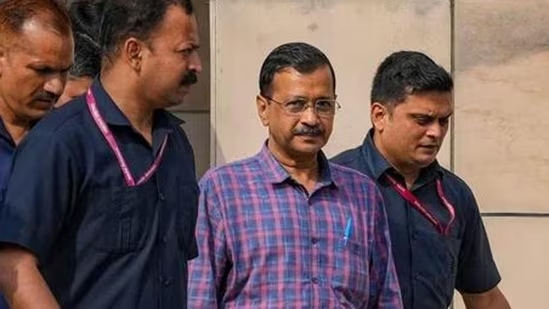
On February 27, 2026, a Special Court in Rouse Avenue, Delhi, discharged former Delhi Chief Minister Arvind Kejriwal and 22 others in the CBI’s Delhi Excise Police Case. The court cited lack of evidence, major procedural lapses, and criticized the investigation as a “premeditated” exercise.
In the article below, we examine the order passed by the Learned Trial Court through a lens of law and find out the legal standpoints relied upon by the court.
CBI vs. KULDEEP SINGH & OTHERS
I. BACKGROUND & PARTIES
The CBI registered an FIR on 17.08.2022 alleging a criminal conspiracy in the formulation and implementation of the Delhi Excise Policy 2021-22 (DEP-21/22). Twenty-three accused were arraigned across one principal and four supplementary charge-sheets, including:
- A-8 Manish Sisodia – then Deputy Chief Minister & Excise Minister
- A-18 Arvind Kejriwal – then Chief Minister
- A-1, A-2 – Excise Department public servants
- A-3 Vijay Nair – AAP media functionary
- A-17 K. Kavitha – Telangana MLC
- A-4 to A-7, A-9 to A-16, A-19 to A-23 – Private businessmen, political workers, media persons, and hawala conduits
Core Prosecution Allegation: The DEP-21/22 was deliberately manipulated to confer undue benefit upon the a so called “South Group” (private liquor interests from South India) in exchange for Rs. 90-100 crores as “upfront money”, part of which (Rs. 44.54 crores) was routed via hawala to fund AAP’s 2022 Goa election campaign.
The investigating agency i.e. CBI, after conducting due investigation against the 23 accused persons, had filed a principal charge sheet along with 3 supplementary charge sheets, before the learned Trial Court for commencement of trial and prosecuting the accused persons in the court.
II. LEGAL FRAMEWORK APPLIED
A. Governing Standard at Stage of Charge
Sections 227 & 228, Cr.P.C.: The Court must determine whether the material discloses grave suspicion (not mere suspicion) warranting trial.
Key Case Law:
Sajjan Kumar v. Bureau of Investigation (2010) 9 SCC 368 Exhaustively settled the 7-pronged test:
- Evaluation of Material for Prima Facie Case: The judge must evaluate the materials/documents placed on record to determine if a prima facie case is made out against the accused.
- Grave Suspicion Requirement: If the records indicate a “grave suspicion” against the accused that remains unexplained, the judge is fully justified in framing charges.
- Standard of Proof vs. Strong Suspicion: The test is not to see if the case is proved to the hilt, but whether there is a “strong suspicion” indicating a ground for presuming that the accused committed the offence.
- Balancing Two Views: If two views are possible and the evidence produced gives rise to some suspicion but not “grave suspicion,” the judge is within their right to discharge the accused.
- Beyond a “Post Office” Role: The judge cannot act merely as a “post office” or mouthpiece of the prosecution. They must apply their mind to the broad probabilities, the total effect of evidence, and any basic infirmities, without engaging in a “roving inquiry” (full trial).
- Discretion in Sifting Evidence: While sifting through evidence, the judge is not expected to meticulously weigh the evidence to determine if it is sufficient for conviction at this initial stage.
- Application to Specific Facts: The application of these tests depends on the specific facts of each case, and no universal formula can be applied.
- Tuhin Kumar Bishwas @ Bumba v. State of West Bengal, 2025 SCC OnLine SC 2604 Reaffirmed that absent strong suspicion on material capable of becoming evidence, accused can be discharged.
- M.E. Shivalingamurthy v. CBI, Bengaluru (2020) 2 SCC 768 If evidence proposed, even if fully accepted, cannot show commission of offence, there is no sufficient ground for trial.
- Karnataka v. L. Muniswamy, MANU/SC/0143/1977 — Court must guard against being carried by the prosecution’s mere presentation.
III. LEGAL PRINCIPLES ON APPROVER EVIDENCE
The prosecution relied heavily on approver Dinesh Arora (PW-20) who gave seven statements (a fact expressly noted as unprecedented by the Court). The court held that the position in law at this stage is well settled. If two views are reasonably possible on the material before the Court, and the view favourable to the accused gives rise only to suspicion and not to grave suspicion, the accused is entitled to discharge. An uncorroborated approver’s statement, unsupported by independent material on material particulars, ordinarily remains within the realm of mere suspicion. It assumes the character of grave suspicion only when reinforced by credible, independent evidence tending to connect the accused with the offence.
Key Principles Applied:
1. Ravinder Singh v. State of Haryana (1975) 3 SCC 742:- An approver is “a most unworthy friend, if at all.” Two-fold test: (i) narrative must implicate himself coherently; (ii) must inspire reasonable assurance of guilt vis-à-vis others. Corroboration in material particulars is the ordinary and salutary rule.
2. Bhiva Doulu Patil v. State of Maharashtra (AIR 1963 SC 599): Reconciled Sections 133 and 114(b) of the Indian Evidence Act. Section 133 (conviction on uncorroborated approver statement not illegal) vs. Illustration (b) to Section 114 (rule of prudence requiring corroboration). Held: corroboration is a practical necessity, not an indulgence.
3. Suresh Budharmal Kalani v. State of Maharashtra (1998) 7 SCC 337: A charge cannot be framed solely on the confession of a co-accused.
4. P. Krishna Mohan Reddy v. State of Andhra Pradesh, 2025 SCC OnLine SC 1157 :- Comprehensively settled the evidentiary value of Section 161 CrPC statements, confessions, and admissions, including that:
- Confessional police statements are inadmissible under Sections 25 & 26, Evidence Act
- Section 30 applies only at trial, with strict conditions
- Admissions by one accused cannot implicate co-accused
- Under Section 30 of Indian Evidence Act, 1872 a confession made by one accused implicating a co-accused can be considered by the court during a joint trial for the same offense, but it is not substantive evidence and requires strong corroboration. Such statements cannot be used as the sole basis for conviction.
5. K. Hashim v. State of T.N. (2005) 1 SCC 237; Somasundaram alias Somu v. State (2020) 7 SCC 722: One accomplice’s statement cannot corroborate another’s. Corroboration must come from independent sources.
6. Laxmipat Choraria v. State of Maharashtra (1968 SCR (2) 624); A.R. Antulay v. R.S. Nayak (1988) 2 SCC 602; R. Dineshkumar @ Deena v. State: Prosecution may examine a participant in the offence as a witness, but such evidence must be treated with the caution applicable to accomplice evidence.
On Section 161 CrPC statements post-pardon: The Court held that supplementary statements recorded under Section 161 after grant of pardon under Section 306(4) cannot be treated as substantive material. What was inadmissible when the maker was a co-accused cannot become admissible merely because pardon was later granted. This was a critical finding against PW-20’s seven statements.
IV. PRINCIPLES ON POLICY FORMULATION & CRIMINAL LIABILITY
The Court laid down an important framework distinguishing policy decisions from criminal conduct:
Three Categories of Policy Prosecution Cases:
- Statutory violations with deliberate bypassing: Criminal liability possible only with material showing dishonest intent beyond mere procedural deviation.
- Formal compliance masking mala fide intent: Prosecution justified only with cogent and independent material, not inferred from policy outcome alone.
- Bona fide policy decisions: No criminal liability even if policy fails or benefits private parties.
V. PRINCIPLES ON CONSPIRACY
Section 120-B IPC:- Agreement is the core:
The Court held that at the stage of charge, prosecution material must prima facie disclose:
- Identity of conspirators inter se (who agreed with whom)
- Content of the agreement (what illegal act or illegal means)
- Temporal and causal linkage (when formed, how subsequent acts furthered it)
- Exclusion of innocent hypotheses
Circumstantial evidence requirements (settled principles):
- Circumstances must be fully established
- Consistent only with guilt
- Must exclude every reasonable hypothesis of innocence
- Chain must be complete
Meetings, CDRs, tower location data: Found to be neutral in policy contexts; cannot substitute evidence of agreement.
VI. DOCUMENTARY EVIDENCE – ANGADIYA RECORDS
Central Bureau of Investigation v. V.C. Shukla (1998) 3 SCC 410 (the Jain Hawala Case) Applied extensively to reject the angadiya “pauti” (loose pencil-written sheets) records:
- “Loose sheets or scraps of paper cannot be termed as ‘book'” not admissible as books of account under Section 34, Evidence Act
- Even genuine entries in books of account cannot, without independent evidence, fix liability
- “An element of self-interest and partisanship of the entrant cannot be ruled out”
The Court found that pauti records (D-series exhibits) being loose, pencil-written, detachable sheets failed this test entirely. The numerical amounts translated by PW-180 (by adding three zeroes) also produced figures far in excess of the prosecution’s claimed ₹44.54 crores, revealing internal inconsistency.
Anvar P.V. v. P.K. Basheer (2014) 10 SCC 473; Vinubhai Haribhai Malaviya v. State of Gujarat (2019) 17 SCC 1 :- Electronic records without Section 65-B certificate are inadmissible.
Central Bureau of Investigation v. V.C. Shukla (supra) also applied to Ace Finance ledger (selective Excel printout) — held inadmissible as not being regularly maintained books.
VII. EVIDENTIARY VALUE OF PUBLIC DOCUMENTS & FILE NOTINGS
Sections 35, 74, 76, 77, Indian Evidence Act: Official notings made by public servants in discharge of official duty are relevant facts. The Court applied this to uphold the LG Secretariat’s file notings over the oral denial of the then LG (PW-86), holding that an unchallenged official record cannot be displaced by subsequent oral variation.
Best Evidence Rule: Where terms of an official act are reduced to writing, the document constitutes best evidence; oral evidence cannot contradict it (Sections 91-92, Evidence Act).
VIII. OUTCOME ON SPECIFIC ACCUSED
A-1 & A-2 (Excise Officials): Discharged. The only allegation of Rs. 30 lakhs bribe to A-2 rested on hearsay in PW-20’s fourth statement (absent from Section 164 CrPC confession). Licence granted in compliance with policy. No demand or acceptance proved. The Court strongly condemned the investigating officer for framing A-1 without any material and recommended departmental proceedings.
A-8 (Manish Sisodia): Discharged. Policy formulated through institutional processes; LG Secretariat file notings show consultation; no clandestine manipulation; no financial trail; no admissible evidence placing him in conspiratorial meetings. The 36-page document theory was contradicted by prosecution’s own witnesses (PW-71: 20-25 pages; PW-72: 25-30 pages). The 12% margin was found economically unviable, not a windfall.
A-18 (Arvind Kejriwal): Discharged. The only material against him was one line in PW-225’s statement (an accomplice-like witness) that K. Kavitha would contact him. No independent corroboration; 10-12 persons allegedly present were never examined; PW-20 (with seven statements) never attributed any role to A-18; no contemporaneous document, financial trail, or overt act.
A-17 (K. Kavitha): Discharged. Land deal was aborted and advance returned; CSR contribution was a banking transaction pre-dating any proceeds generation; proxy investment theory unsupported; accomplice-like witnesses (PW-225, PW-226) cannot corroborate each other.
A-3 (Vijay Nair): Discharged. No admissible material showing any meeting of minds with public servants; no financial trail; policy meetings rested on uncorroborated approver testimony; the PRI appointment of Indospirits was a commercial decision; the conspiracy theory was internally contradictory.
A-12 to A-16, A-21, A-22 (Goa Election Chain): Discharged. Angadiya pauti records inadmissible under V.C. Shukla; accomplice-like witnesses cannot corroborate each other; no link to the predicate Excise Policy offence; PW-180’s numerical method produced figures irreconcilable with the prosecution’s own Rs. 44.54 crore claim; electoral expenditure is within the ECI’s exclusive jurisdiction.
A-19 (Durgesh Pathak): Discharged. No overt act; no cash handling; political supervision of elections is lawful; no meeting of minds shown; impermissible vicarious liability theory.
A-20 (Amit Arora): Discharged. Not present at any conspiratorial meeting; Punjab Excise sanction denied and unchallenged (applying Karnataka Emta Coal Mines Ltd. v. CBI, 2024 SCC OnLine SC 2250); no link to policy; conspiracy cannot survive against private persons when public servants are exonerated.
A-6, A-9, A-10, A-11, A-23: Discharged on similar grounds i.e. no independent material, no mens rea, transactions pre-dating conspiracy, commercially explicable conduct, or legally neutral acts.
IX. NOTABLE JUDICIAL OBSERVATIONS
- On investigating officer’s conduct: Strong adverse observations made. The investigating agency was found to have misrepresented receipt of PW-20’s pardon statement to the Court. The Court found the investigation to be “steered by a preconceived outcome” and described it as a “pre-meditated and choreographed exercise” recommending departmental action against the IO for framing A-1 without material, relying on Gajoo v. State of Uttarakhand (2012) 9 SCC 532.
- On the “South Group” label: Strongly deprecated as an inappropriate, regionally stigmatic descriptor inconsistent with Article 15 and the right to a fair trial, referencing United States v. Cabrera, 222 F.3d 590 (7th Cir. 2000).
- On PMLA and pre-trial detention: Cautioned against using PMLA proceedings to avoid default bail while the predicate offence investigation remains incomplete, relying on Vijay Madanlal Choudhary v. Union of India (2022) 10 SCC 353 and Manish Sisodia v. State (NCT of Delhi) (2023) 9 SCC 772.
- On election expenditure: Held that investigative agencies cannot unilaterally audit election expenditure. This falls within the exclusive constitutional jurisdiction of the Election Commission under Article 324, with the remedy being an election petition under the Representation of the People Act, 1951. Relying on State of West Bengal v. Committee for Protection of Democratic Rights (2010) 3 SCC 571.
- On approver selection: The Court raised concern that PW-20 appeared to be a principal conspirator yet was granted pardon, inverting the jurisprudential rationale that pardon is for persons of comparatively lesser culpability. Referenced Suresh Chandra Bahri v. State of Bihar (1995 Supp (1) SCC) on the mandatory custody requirement for approvers.
- On unrelied documents: Called for reasoned recording of why material is classified as “unrelied,” as exclusion of potentially exculpatory material undermines Article 21 guarantees and India’s obligations under the ICCPR (Article 14).
CONCLUSION:
The learned Trial court had after appreciating the Final Report filed by the CBI, found the foundational facts missing from the case of prosecution and thereupon and therefore the learned trial court discharged all the accused persons from the case with remark that materials does not disclose even a prima facie case.
Result: All 23 accused were discharged by the learned Trial Court for the want of strong prima facie case against the accused persons. The Learned Trial Court in its order had re iterated and relied upon the mandate of law that at the stage of framing of charges the trial court shall not act as a mere post office and mouth piece of the prosecution and the court shall weigh the evidence to find out if grave suspicion arises against the accused persons or not. The learned trial court held that after going through the evidence adduced by the prosecution, no grave apprehension arises against an of the accused persons. Hence all were discharged.
However, CBI has challanged the order in the Delhi High Court and the same is pending adjudication.
Contributed by Aasish Pandey, Associate, Law Offices of Kr. Vivek Tanwar