
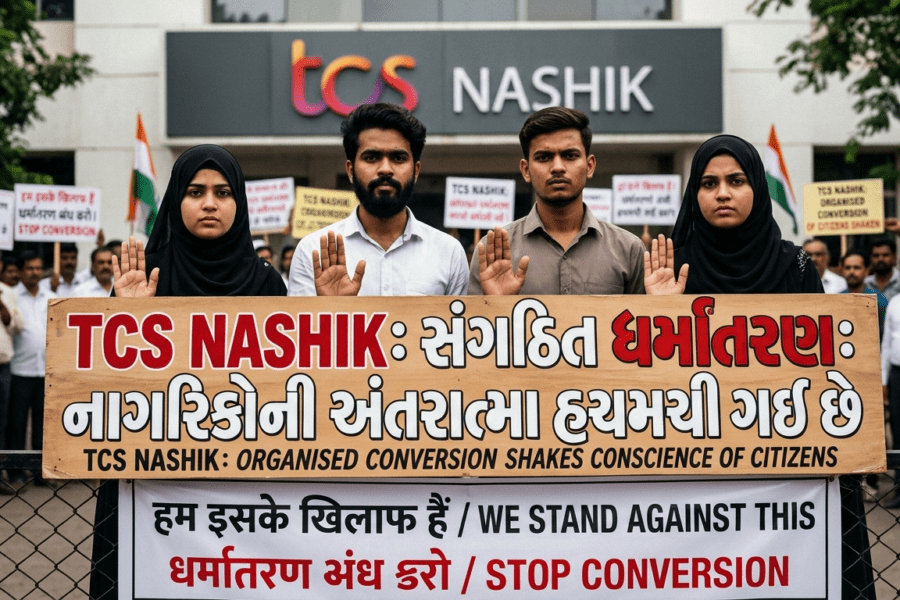
As of April 2026, the TCS Nashik case has become a landmark legal and corporate controversy involving allegations of organized religious conversion and sexual harassment. A significant plea was filed in the Supreme Court of India on April 16, 2026, seeking to classify such organized forced conversions as “terrorist acts” under the Bharatiya Nyaya Sanhita (BNS), 2023.
1. Voluntary Conversion: A Constitutional Right
Voluntary conversion is the act of renouncing one’s faith and adopting another based on personal conviction.
- Constitutional Protection: Under Article 25, every citizen has the freedom of conscience and the right to profess, practice, and propagate their religion.
- The “Notice” Requirement: In 2026, even voluntary conversion is not entirely “private.” Any individual intending to convert must submit a declaration to the DM at least 60 days in advance. This allows the state to conduct an inquiry to ensure the decision is not influenced by force or fraud.
2. Organized Conversion: A Regulated Offense
Organized conversion (often referred to as Mass Conversion) is defined as the conversion of multiple people simultaneously or through a systematic, institutional campaign.
- The “Inducement” Factor: Organized efforts are often scrutinized for “allurement” (promises of money, gifts, or employment) and “undue influence”.
- Institutional Liability: Under new laws, if an institution (like an NGO or office unit) is found facilitating organized conversion, its registration can be canceled, and its office-bearers can face imprisonment.
3. Who Can File a Complaint?
In 2026, the scope for reporting has expanded. Even if a person converts “voluntarily,” a complaint can be filed by:
- The individual themselves.
- Parents or siblings.
- Relatives by blood, marriage, or adoption.
- Case Overview: The “Covert” Exposure
The controversy began in February 2026 when a political party worker alerted Nashik City Police that a Hindu woman at the TCS facility was allegedly being influenced to observe Islamic fasts.
- The Covert Operation: To verify the claims, police conducted a 40-day undercover operation, deploying female constables disguised as housekeeping staff inside the TCS campus.
- Discovery: The operation revealed that several team leaders and managers were allegedly running a coordinated campaign of sexual harassment and religious coercion targeting young female employees, aged primarily between 18 and 25.
5. Detailed Allegations and Modus Operandi
At least nine FIRs have been registered based on complaints from eight female employees and one male employee. The victims describe a “systematic conspiracy” that unfolded over two to three years.
A. Systematic Harassment
Victims alleged that senior colleagues used their professional authority to manipulate them:
- Workplace Pressure: Employees who refused to “play along” with religious suggestions were reportedly burdened with excessive work assignments or denied promotions.
- Sexual Misconduct: The FIRs detail instances of inappropriate touching, lewd remarks about marital status, stalking, and in one case, a senior colleague allegedly engaged in a sexual relationship under a false promise of marriage.
B. Forced Conversion Tactics
According to the investigation and statements by Maharashtra Minister Girish Mahajan, the accused used a variety of coercive tactics:
- Religious Rituals: Victims were allegedly pressured to offer namaz, observe roza (fasting), and learn Islamic teachings at the workplace.
- Dietary Coercion: Some victims claimed they were forcefully fed beef, violating their religious sentiments.
- Financial and Professional Allure: The racket allegedly lured vulnerable employees with promises of salary hikes and high-paying jobs abroad.
6. The Supreme Court Plea: Conversion as Terrorism
On April 16, 2026, advocate Ashwini Kumar Upadhyay filed a petition in the Supreme Court of India in the direct aftermath of the Nashik scandal.
- The Central Argument: The plea contends that forced/deceitful religious conversion, when carried out as a systematic and organized campaign, should be declared a “terrorist act” under Section 113 of the Bharatiya Nyaya Sanhita (BNS), 2023.
- National Security Threat: The petition argues that such “organized” conversions are often funded by foreign entities to alter India’s demographic balance, thereby threatening the sovereignty and security of the nation.
- Demands:
- Directions to the Centre and States to establish Special Courts for conversion cases.
- Declaration that sentences for such crimes should be consecutive, not concurrent.
- Clarification that the right to “propagate” religion under Article 25 does not include the right to convert via fraud or coercion.
7. Legislative and Corporate Impact
A. Maharashtra Freedom of Religion Bill 2026
The case accelerated the passage of the Maharashtra Freedom of Religion Bill 2026 (approved March 17, 2026), which introduces:
- 7-10 years of imprisonment for unlawful conversions.
- Non-bailable status for mass conversion offenses.
- A requirement for individuals to give 60-day prior notice to the District Magistrate before converting.
B. Corporate Accountability
TCS Chairman N. Chandrasekaran described the allegations as “gravely concerning and anguishing,” confirming that the accused employees have been suspended. The case has forced a nationwide re-evaluation of POSH compliance, with legal experts noting that if internal committees abet harassment by inaction, they may be held criminally liable alongside the perpetrators.
8. Voluntary Conversion: A Constitutional Right
Voluntary conversion is the act of renouncing one’s faith and adopting another based on personal conviction.
- Constitutional Protection: Under Article 25, every citizen has the freedom of conscience and the right to profess, practice, and propagate their religion.
- The “Notice” Requirement: In 2026, even voluntary conversion is not entirely “private.” Any individual intending to convert must submit a declaration to the DM at least 60 days in advance. This allows the state to conduct an inquiry to ensure the decision is not influenced by force or fraud.
9. Organized Conversion: A Regulated Offense
Organized conversion (often referred to as Mass Conversion) is defined as the conversion of multiple people simultaneously or through a systematic, institutional campaign.
- The “Inducement” Factor: Organized efforts are often scrutinized for “allurement” (promises of money, gifts, or employment) and “undue influence”.
- Institutional Liability: Under new laws, if an institution (like an NGO or office unit) is found facilitating organized conversion, its registration can be canceled, and its office-bearers can face imprisonment.
10. Who Can File a Complaint?
In 2026, the scope for reporting has expanded. Even if a person converts “voluntarily,” a complaint can be filed by:
- The individual themselves.
- Parents or siblings.
- Relatives by blood, marriage, or adoption.
Conclusion
The TCS Nashik case has moved beyond a local crime to a constitutional debate. It highlights a critical intersection where workplace safety, corporate governance, and national security collide. The pending Supreme Court ruling on whether such acts constitute “terrorism” will define the legal boundaries of religious freedom in India for decades to come.
Contributed By:- Advocate Seema Choudhary