
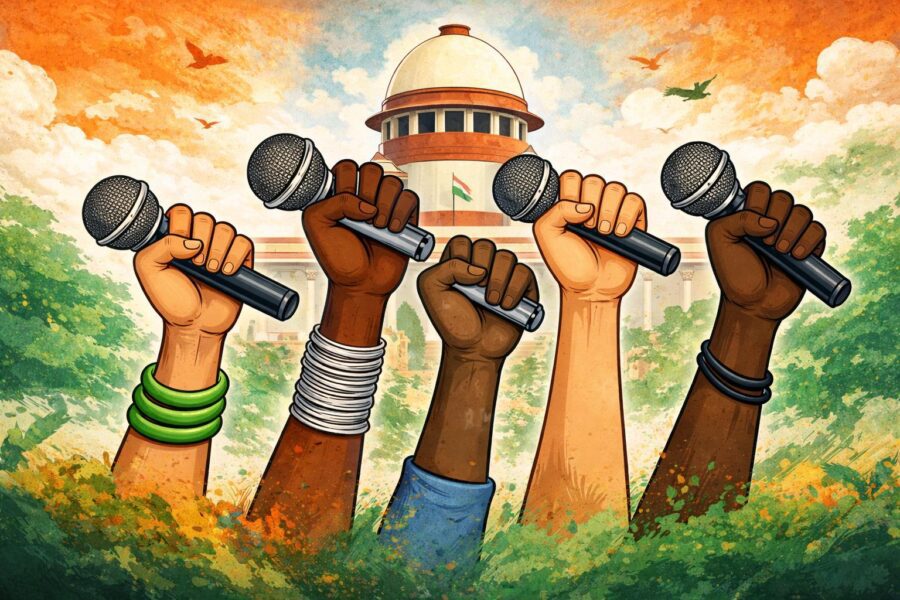
The exponential growth of digital platforms has fundamentally altered the nature, reach, and impact of speech in India. While the Constitution guarantees freedom of speech and expression under Article 19(1)(a), the increasing reliance on online takedown mechanisms exercised by both the State and private intermediaries has generated serious constitutional concerns. This article undertakes a critical examination of the legal and institutional frameworks governing online speech regulation in India, focusing on the problematic reliance on “offensiveness” as a ground for censorship. Through an analysis of statutory provisions, judicial precedents, constitutional theory, and recent developments as of early 2026, it argues that vague standards, executive overreach, and privatized censorship threaten democratic discourse and undermine the foundational principles of free expression.
The internet has emerged as the most significant public forum of the twenty-first century. In India, social media platforms have replaced traditional town squares, newspapers, and television debates as primary sites of political engagement. Citizens now express dissent, critique state action, mobilize movements, and shape public opinion through digital speech. However, this transformation has also unsettled the State. The absence of editorial control, the speed of dissemination, and the potential for mass mobilization have led to increased governmental intervention in online spaces. Content takedowns, blocking orders, and platform-level moderation have become routine mechanisms of control. The central constitutional dilemma is not whether online speech should be regulated, but how such regulation aligns with the principles of free expression, legality, and accountability. At the core of this dilemma lies an ambiguous and dangerous standard: “offensiveness.” Recent years have seen a surge in takedown demands, with mechanisms like the Sahyog portal enabling rapid, often opaque removals that bypass traditional safeguards.
Freedom of speech under Article 19(1)(a) is not merely an individual liberty; it is a structural necessity for democracy. The Supreme Court has repeatedly recognised that free expression enables informed decision-making, political participation, and institutional accountability. In Romesh Thapar v. State of Madras (1950), the Court described freedom of speech as the “foundation of all democratic organisations.” This view was reaffirmed in Brij Bhushan v. State of Delhi (1950), where pre-censorship of publications was held to be constitutionally suspect.
Importantly, Indian constitutional jurisprudence does not limit free speech to agreeable or civil expression. In S. Rangarajan v. P. Jagjivan Ram(1989), the Court held that intolerance of unpopular views is incompatible with democracy and that the State must protect speech unless there is a clear threat to public order. Thus, the constitutional scheme prioritises tolerance over suppression, even at the cost of discomfort. In the digital era, this principle is tested as never before, with the Supreme Court in 2025 emphasising proportionality and caution against interim censorship that can have lasting effects on online discourse.
Article 19(2) permits restrictions on speech only on specific grounds such as public order, morality, decency, and security of the State. These grounds are exhaustive, not illustrative. Any restriction outside these categories is constitutionally impermissible. The Supreme Court has developed robust tests to assess the validity of restrictions. In Superintendent, Central Prison v. Ram Manohar Lohia (1960), the Court held that restrictions must have a proximate and direct nexus with the protected interest. Remote or speculative harm is insufficient.
Similarly, the doctrine of proportionality now firmly entrenched in Indian constitutional law requires that restrictions be necessary, narrowly tailored, and the least restrictive means available (Modern Dental College v. State of Madhya Pradesh, 2016). When online speech is curtailed merely because it offends sentiments, these safeguards are bypassed. Recent judicial observations in 2025 have reiterated the need for detailed reasoning and proportionality in digital takedowns, warning against overreach that chills expression.
Section 69A and Blocking Powers : Section 69A of the Information Technology Act, 2000, authorises the Central Government to block online content in the interest of sovereignty, security, and public order. The provision grants sweeping powers to the executive, with minimal public scrutiny. In Shreya Singhal v. Union of India (2015), the Supreme Court upheld Section 69A only because of the procedural safeguards in the Blocking Rules, such as reasoned orders and limited grounds. The Court emphasised that blocking must be an exception, not the norm. However, in practice, blocking orders are often confidential, inaccessible, and unchallengeable. The secrecy surrounding such orders prevents meaningful judicial review and undermines the rule of law. The number of takedown demands has risen dramatically, from 471 in 2014 to over 6,775 in 2022, with further escalation through newer mechanisms.
A significant recent development is the Sahyog portal, launched in late 2024 and formalized through the 2025 amendments to the IT Rules. Operating under Section 79(3)(b), it allows government agencies including state and district-level officials to issue takedown demands, bypassing the stricter procedures of Section 69A. From October 2024 to June 2025, nearly 300 demands targeted over 3,400 URLs, including critical posts on events like the Kumbh Mela stampede and India-Pakistan tensions. While the 2025 amendments introduced some safeguards such as limiting directions to senior officers, requiring reasoned notices, and mandating monthly reviews the regime still lacks transparency, pre-decisional hearings, and independent oversight, raising concerns of unchecked executive power.The striking down of Section 66A in Shreya Singhal is particularly instructive. The Court held that terms like “grossly offensive” and “annoying” were unconstitutionally vague and had a chilling effect on speech. Despite this landmark ruling, similar vague standards continue to inform online regulation through executive action and intermediary guidelines. The continued reliance on subjective notions of offensiveness represents a failure to internalise constitutional principles.
Offensiveness lacks any objective legal standard. In a plural society like India, offence is inevitable and unavoidable. Allowing offence to become a legal threshold effectively empowers the most sensitive or politically mobilised group to silence dissent. The Supreme Court has consistently rejected this approach. In K.A. Abbas v. Union of India (1970), the Court acknowledged that freedom of expression may disturb or shock sections of society, but such disturbance is intrinsic to democratic discourse. Similarly, in Bijoe Emmanuel v. State of Kerala (1986), the Court protected the right of students to refrain from singing the national anthem, holding that mere discomfort to others cannot justify suppression. Yet, online speech continues to be criminalised through FIRs and investigations based on perceived offence, turning the criminal process into a punitive tool. Recent takedowns under Sahyog have targeted content deemed offensive to state narratives, amplifying this risk.
One of the most significant developments in online speech regulation is the rise of private intermediaries as primary regulators of expression. Social media platforms enforce content moderation through internal policies that often lack transparency, consistency, and contextual sensitivity. These platforms are incentivised to remove content quickly to avoid legal liability, adopting overbroad practices that disproportionately affect political speech, satire, and minority viewpoints. The 2025 amendments to the Intermediary Rules retain the 36-hour compliance timeline but require reasoned, specific directions from senior officials and remove the Good Samaritan proviso that protected voluntary moderation. This shift heightens pressure on platforms to comply, effectively privatizing censorship.
Although intermediaries are nominally independent, government influence shapes their moderation decisions. Takedown requests, informal pressures, and regulatory threats create an environment of compelled compliance. Platforms like Meta, Google, and others have joined Sahyog, appointing staff to handle demands, while X has resisted, challenging it in court. This leads to selective enforcement, where speech critical of governmental authority faces greater scrutiny than aligned narratives, distorting democratic discourse and eroding public trust.
Courts have attempted to adapt constitutional principles to digital realities. In Anuradha Bhasin v. Union of India (2020), the Supreme Court held that access to the internet is integral to freedom of speech and that restrictions must satisfy proportionality and necessity. In 2025, the Court set aside interim takedown orders in cases like Wikimedia Foundation v ANI, stressing caution against digital censorship and the need for proportionality. However, judicial remedies often arrive after irreversible harm. Online speech is ephemeral and context-sensitive; delayed relief cannot restore lost relevance or impact. Litigation remains inaccessible to many speakers, reinforcing power imbalances.
The cumulative effect of vague laws, executive discretion, private censorship, and mechanisms like Sahyog is a chilling effect on speech. Citizens self-censor to avoid legal entanglements, particularly when expressing dissenting or unpopular views. This erosion of expressive freedom weakens democratic accountability. Without robust criticism, institutions stagnate and power goes unchecked. As Justice Khanna famously observed, the Constitution does not require unanimity it requires liberty.The regulation of online speech must be anchored in constitutional morality, not administrative convenience or popular sentiment. Offensiveness cannot serve as a legal standard for censorship without hollowing out the very idea of free expression. The power to silence speech must remain constrained, transparent, and accountable.
In a constitutional democracy, the default response to speech should be tolerance, not suppression. If the digital public sphere is to remain a space for democratic engagement rather than controlled conformity, India must reaffirm its commitment to free expression not as a privilege, but as a constitutional imperative. Ongoing challenges to the Sahyog regime and IT Rules amendments offer an opportunity to restore safeguards and ensure that the digital square serves democracy, not domination.
Contributed By : Harsha Vardhan