
INTRODUCTION
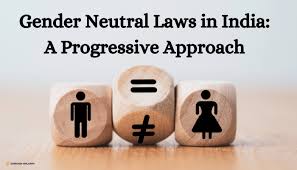
The idea of gender neutrality in law has gained significant attention in India over the past decade. Traditionally, Indian laws—particularly criminal laws—have been drafted on the assumption that women are victims and men are perpetrators. While such an approach was historically justified to protect women from systemic discrimination and violence, changing social realities and constitutional jurisprudence now demand a re-examination of this gender-specific framework. Gender-neutral laws aim to provide equal legal protection to all individuals, irrespective of gender identity, sex, or sexual orientation. This article critically examines the concept of gender-neutral laws in India, the constitutional basis for such laws, and the major legislative and judicial developments in recent years.
CONCEPT OF GENDER NEUTRALITY IN LAW
Gender-neutral laws refer to those laws that do not differentiate people according to their gender and understand that victims and perpetrators of crimes may represent any gender. The constitutional basis of gender neutrality is in Article 14 which gives the equality in the eyes of the law; in Article 15, which supports the prohibition of discrimination according to sex; and in Article 21, which supports the right to live and personal freedom, including dignity and control over the body.
But Article 15 (3) further authorizes the State to enact special treatment to women. This has seen the enacting of a number of gender specific protective laws. The difficulty, however, is to find the balance between substantive equality, acknowledging historical disadvantage, and formal equality, which involves equal treatment of both genders.
HISTORICAL BACKGROUND OF GENDER-SPECIFIC LAWS IN INDIA
Indian criminal law has largely been gender-specific. Provisions such as rape under Section 375 IPC, Section 498A IPC (cruelty by husband or relatives), and the Protection of Women from Domestic Violence Act, 2005, were designed to address violence primarily faced by women. While these laws have played a crucial role in empowering women, they have also been criticized for excluding male and transgender victims from legal protection.
Judicial decisions such as Sushil Kumar Sharma v. Union of India acknowledged the misuse of certain gender-specific provisions, but the Supreme Court consistently held that misuse alone cannot be a ground to strike down a law intended to protect a vulnerable class.
MAJOR LEGISLATIVE DEVELOPMENTS IN RECENT YEARS
BHARATIYA NYAYA SANHITA, 2023
One of the most significant recent developments is the enactment of the Bharatiya Nyaya Sanhita, 2023 (BNS), which replaced the Indian Penal Code, 1860. The BNS has introduced gender-neutral language in several offences, particularly those relating to crimes against children and trafficking.
Key changes include:
- Replacement of terms like “minor girl” with “child,” thereby recognising that boys can also be victims of sexual and exploitative crimes.
- Gender-neutral drafting in provisions related to kidnapping, trafficking, and procurement of children.
However, despite these progressive changes, the offence of rape under the BNS continues to remain gender-specific, where the victim is defined as a woman. This selective approach has sparked debate on whether partial gender neutrality is sufficient or whether a comprehensive reform is necessary.
PROTECTION OF CHILDREN FROM SEXUAL OFFENCES ACT, 2012 (POCSO)
The POCSO Act stands out as India’s most effective gender-neutral criminal statute. It recognises that children of all genders can be victims of sexual abuse and provides uniform protection without gender discrimination. Courts have consistently interpreted POCSO as gender neutral, even allowing prosecution of female offenders.
The gender-neutral nature of POCSO reflects a growing judicial and legislative acknowledgment that vulnerability, rather than gender, should be the guiding factor in determining legal protection.
JUDICIAL CONTRIBUTION TO GENDER NEUTRALITY
The Indian judiciary has played a pivotal role in advancing gender-neutral interpretations.
Navtej Singh Johar v. Union of India (2018)
The Supreme Court decriminalised consensual same-sex relations by partially striking down Section 377 IPC. The judgment emphasised dignity, autonomy, and equality, thereby expanding the understanding of gender and sexuality beyond the binary framework.
Joseph Shine v. Union of India (2018)
The Court struck down the offence of adultery, holding that it violated gender equality and personal liberty. The judgment rejected patriarchal notions that treated women as property, reinforcing the need for gender-neutral legal reasoning.
Independent Thought v. Union of India (2017)
By reading down the marital rape exception for minors, the Court recognised the importance of consent and bodily autonomy, even within marriage.
These judgments collectively demonstrate a judicial shift from protectionist approaches to rights-based and gender-inclusive interpretations.
Gender Neutrality and Domestic Violence Laws
One of the most debated issues in Indian law is whether domestic violence laws should be made gender neutral. The Protection of Women from Domestic Violence Act, 2005 provides civil remedies exclusively to women. Critics argue that men and persons from the LGBTQ+ community facing domestic abuse are left without effective legal remedies.
Supporters of the existing framework contend that domestic violence disproportionately affects women and that gender-specific protection is justified under Article 15(3). This debate highlights the tension between gender neutrality and gender justice in Indian society.
GENDER NEUTRALITY AND LGBTQ+ RIGHTS
The recognition of transgender persons under the Transgender Persons (Protection of Rights) Act, 2019 and judicial recognition of diverse gender identities reflect India’s gradual move towards inclusivity. However, the absence of gender-neutral sexual offence laws continues to leave transgender and non-binary persons vulnerable.
The evolving jurisprudence indicates that future reforms may need to incorporate gender identity as a legally protected category rather than limiting protection to biological sex.
CHALLENGES AND CONCERNS
Despite progress, several challenges remain:
- Fear of Dilution of Women’s Protection: Women’s rights groups argue that gender neutrality may weaken safeguards in a deeply patriarchal society.
- Misuse vs. Under-reporting: While misuse of laws is often highlighted, under-reporting of gender-based violence remains a larger concern.
- Lack of Societal Readiness: Legal reforms without social sensitisation may fail to achieve their intended objectives.
CONCLUSION
In India, gender-neutral laws are slowly becoming a reality with the introduction of such reforms in legislations and the application of judicial interpretation. The evolution of Bharatiya Nyaya Sanhita, the legal acknowledgment of rights of LGBTQ+ and the gender-neutral child protection regulations point to the transition to the inclusive justice. India has, however, taken a conservative and discriminating line, keeping gender-specific safeguards in those areas of social fact where they are necessary.
The future of gender neutrality on the Indian law is in achieving a balance between equality and equity. The vulnerable groups should not be excluded by the laws as there are others that can as well be affected by the same harms. Even though constitutional values still shape the process of reforming the law, gender neutrality cannot be viewed as the threat to the rights and freedoms of all women but rather as the way to provide dignity and justice to everyone.
Contributed by : Akash Singh