
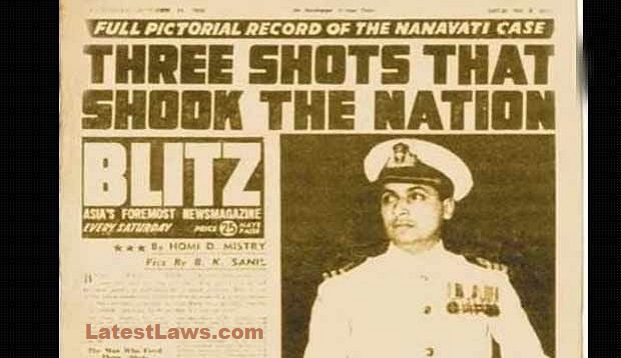
The K.M Nanavati V State of Maharashtra is one of the most intriguing and significant cases in the history of Indian jurisprudence. It mainly involved Commander Manack Shaw Nanavati, a naval officer, who was tried for the murder of his wife’s paramour, Prem Ahuja. This appeal by special leave arises out of the judgment of the Bombay High Court sentencing Nanavati, the appellant, to life imprisonment for the murder of Prem Bhagwandas Ahuja, a businessman of Bombay. This appeal presents the commonplace problem of an alleged murder by an enraged husband of the lover of his wife : but it aroused considerable interest in the public mind by reason of the publication it received and the important constitutional point it had given rise to at the time of its admission.
With the aid of the special jury, the appellant was tried in the sessions court in Bombay and was charged under section 302 as well as section 304, part I, of the Indian Penal Code . The learned Sessions Judge submitted the case under section 307 of the Code of Criminal Procedure to the Bombay High Court after recording the grounds for his opinion. The said reference was heard by a division bench of the said High Court consisting of Shelat and Naik, JJ. The two learned Judges gave separate judgments, but agreed in holding that the accused was guilty of the offence of murder under section 302 of the Indian Penal Code and sentenced him to undergo rigorous imprisonment for life. Shelat, j., having held that there were misdirections to the jury, reviewed the entire evidence and came to the conclusion that the accused was clearly guilty of the offence of murder, alternatively, he expressed the view that the verdict of the jury was perverse, unreasonable an, in any event, contrary to the weight of evidence. Naik, J., preferred to base his conclusion on the alternative ground, namely, that no reasonable body of persons could have come to the conclusion arrived at by the jury. Both the learned agreed that no case had been made out to reduce the offence from murder to culpable homicide not amounting to murder. The present appeal has been preferred against the said conviction and sentence.The sessions judge, being unsatisfied by the verdict of the jury has submitted the case under section 307 of Code of Criminal Procedure, 1898 to the Bombay High Court. The said reference was heard by a division bench of High Court.
The petitioners, fundamentally the counsel for K.M Nanavati, argued that it was not a premediated murder rather a result of sudden and grave provocation. They submitted that Mr.Nanavati wanted to commit suicide after learning about his wife’s illicit relationship with Ahuja. He then drove his wife to the theatre went to his ship and took the handgun and 6 bullets that he had taken to shoot himself. He then went to Ahuja’s office and when he did not find him he moved to Ahuja’s house. Nanavati asked Ahuja that will he marry his wife and look after his children to which Ahuja replied “Am I to marry every woman I sleep with? In a fit of rage, Nanavati took the revolver out of the envelop and fired three shots at Ahuja. Thus, they claim that he should be served under the defence of ‘sudden and grave provocation’. On the other hand, the counsel for the respondent submitted that when Ahuja’s dead body was found he was wearing a towel and it is unlikely that during the fight the towel had not fallen. As a witness, Ahuja’s servant claimed that three shots were fired in quick succession and which was less than a minute which cannot be possible when there was a fight. As per the Deputy Commissioner, after correcting Prem Ahuja, Nanavati corrected his name misspelling file which shows that he is of rational thought. Thus, respondents argued that it was not a crime that occurred at the heat of the moment but rather it was a premediated murder.
The doctrine of provocation is a well established principle recognized in exception 1 to Section 300 IPC, 1860. This principle is used to reduce the criminal liability of the accused from murder to culpable homicide not amounting to murder in cases of intentional killing, which was a reaction towards grave and sudden provocation. Grave and sudden provocation as a principle gain its rational mainly from two principles, where one suggests the reduction of the criminal liability of the accused because he was provoked to the extent where he was not able to reason, while the other indicates that the liability should be reduced since the deceased was the one who provoked him to that extent.
In conclusion, after viewing the evidence and hearing both sides of the argument, the honourable Supreme Court held that it was a premediated murder and not occurred in the heat of the moment. Hence, according to the apex court, the ground of grave and sudden provocation could not be laid. The Supreme Court noted that the cooling off period was there for Nanavati to calm down and make a decision since there was sufficient time between dropping of his wife and kids to the theatre and shooting Mr Prem Ahuja. Hence, the Supreme Court held Nanavati guilty of murder under section 302 of the IPC and punished him with life imprisonment thereby upholding the decision of the Bombay High Court. The apex court also stated that if the Special Leave Petition is submitted to the honourable court then the governor cannot exercise his/her pardoning power.
Contributed by: Ahaana Kashyap