
Introduction
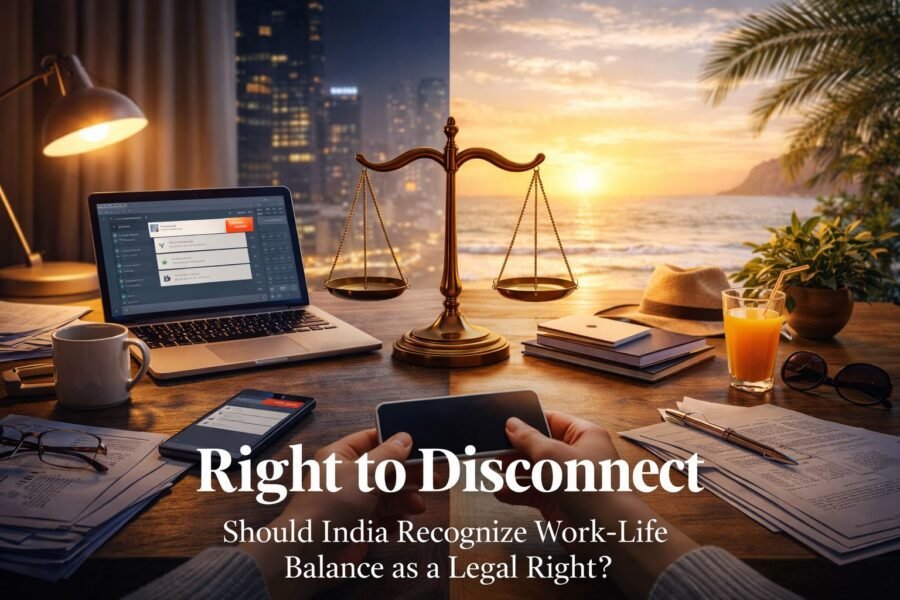
In today’s fast-paced and digitally connected world, the boundary between professional and personal life has become increasingly blurred. With the rise of smartphones, emails, and remote working systems, employees are often expected to remain available even after working hours. This constant connectivity has led to stress, burnout, and a decline in overall well-being. In this context, the concept of the “Right to Disconnect” has gained global attention as a possible legal solution to protect employees from work-related obligations outside office hours.
The right to disconnect refers to an employee’s right to disengage from work communications such as emails, calls, or messages during non-working hours without facing any negative consequences. While countries like France and Spain have already introduced laws in this regard, India is still in the early stages of discussing whether such a right should be legally recognised. This article examines the need, challenges, and implications of introducing the right to disconnect as a legal right in India.
Understanding the Right to Disconnect
The right to disconnect is a labour right that allows employees to maintain a clear separation between work and personal life. It ensures that workers are not required to respond to work-related communications beyond their designated working hours. The idea is not to reduce productivity but to create a healthier work environment where employees can rest and recharge.
This concept has become particularly relevant after the COVID-19 pandemic, which normalised remote working and blurred traditional work schedules. Employees often find themselves working late hours or responding to messages during weekends, leading to mental fatigue and reduced efficiency. The right to disconnect aims to address this issue by promoting work-life balance and protecting employees from exploitation. It recognises that rest and personal time are essential for both physical and mental health.
Global Perspective
Several countries have already taken steps to recognise the right to disconnect as a legal right. France was one of the first countries to introduce such a law in 2017, requiring companies to establish clear policies on after-hours communication. Similarly, Spain and Italy have also adopted measures to protect employees from excessive work demands outside office hours.
These developments are rooted in the broader recognition of human dignity and well-being. Courts in different jurisdictions have emphasised the importance of balancing work and personal life. For instance, the European approach to labour rights is influenced by the idea that excessive working hours can violate basic human rights related to dignity and health.
Legal Position in India
In India, there is currently no specific law that grants employees the right to disconnect. However, certain constitutional and judicial principles indirectly support this idea. Article 21 of the Constitution guarantees the right to life and personal liberty, which has been interpreted to include the right to live with dignity.
In Maneka Gandhi v. Union of India, the Supreme Court expanded the scope of Article 21, emphasising that life is not merely about survival but includes the right to live with dignity. This interpretation forms the foundation for recognising rights that improve quality of life.
Further, in the case of K.S. Puttaswamy v. Union of India, the Court recognised the right to privacy as a fundamental right under Article 21. The judgment highlighted the importance of personal autonomy and the right of individuals to control their personal space. The idea of disconnecting from work during personal time can be linked to this right to privacy.
Additionally, in Bandhua Mukti Morcha v. Union of India, the Supreme Court emphasised humane working conditions and protection of workers’ dignity. Although not directly related to digital work, the principles laid down in this case support the need for fair and reasonable working conditions.
Need for Recognising the Right to Disconnect in India
The need for a right to disconnect in India is becoming increasingly evident due to several reasons. Firstly, the rise of remote work and digital communication has significantly increased work-related stress. Employees often feel obligated to remain available at all times, which affects their personal lives and mental health.
Secondly, India has a highly competitive work culture, where long working hours are often seen as a sign of dedication. This creates pressure on employees to stay connected even during their off-time. The judiciary has also acknowledged the importance of mental well-being. In Consumer Education and Research Centre v. Union of India, the Supreme Court held that the right to health and medical care is a fundamental right under Article 21. This judgment supports the idea that protecting mental health is equally important.
Thirdly, the lack of clear boundaries between work and personal life can lead to burnout, reduced productivity, and job dissatisfaction. Recognising the right to disconnect can help create a healthier work environment and improve overall efficiency.
Challenges in Implementing the Right to Disconnect
While the idea of the right to disconnect is appealing, its implementation in India presents several challenges. One major issue is the nature of modern work, which often requires flexibility and availability across different time zones, especially in multinational companies.
Another challenge is the diversity of India’s workforce. The informal sector, which employs a large portion of the population, may not benefit from such a law due to lack of regulation and enforcement. Employers may also resist such regulations, arguing that it could affect productivity and business operations. In some industries, such as IT and customer service, continuous availability is often necessary. Additionally, enforcing the right to disconnect may be difficult. Monitoring compliance and ensuring that employees are not indirectly pressured to work after hours can be a complex task.
Balancing Employer and Employee Interests
For the right to disconnect to be effective, it is important to strike a balance between the interests of employers and employees. Employers need flexibility to manage their operations, while employees need protection from excessive work demands.
Judicial reasoning in labour welfare cases supports this balance. In Occupational Health and Safety Association v. Union of India (principle-based reference), courts have emphasised that economic development should not come at the cost of workers’ well-being. One possible solution is to adopt a flexible approach, where companies can create their own policies based on the nature of their work. Instead of a rigid law, guidelines can be introduced to encourage fair practices.
Way Forward
India needs to take gradual and practical steps towards recognising the right to disconnect. The first step could be the introduction of clear guidelines or policies rather than strict laws. This would allow both employers and employees to adapt to the concept. Awareness campaigns can also play an important role in educating people about the importance of work-life balance. Employers should be encouraged to adopt best practices that promote employee well-being.
The government can also consider introducing legislation that provides basic protection while allowing flexibility for different industries. Such a law should include safeguards to prevent misuse and ensure fair implementation. Strengthening labour laws and improving enforcement mechanisms will also be essential in making the right to disconnect effective.
Conclusion
The right to disconnect is an important concept that reflects the changing nature of work in the digital age. It highlights the need to protect employees from the negative effects of constant connectivity and to promote a healthy work-life balance. Judicial interpretations of Article 21, particularly in cases like Maneka Gandhi v. Union of India and K.S. Puttaswamy v. Union of India, provide a strong constitutional basis for recognising such a right in India. While India has not yet recognised this right as a law, the growing discussion around it indicates that change may not be far away. Introducing such a right can help create a more balanced and productive work environment.
Ultimately, the goal should be to ensure that employees are able to work efficiently without compromising their personal lives. Recognising the right to disconnect can be a significant step towards achieving this balance and promoting overall well-being in society.
CONTRIBUTED BY: ARYAN POONIA