
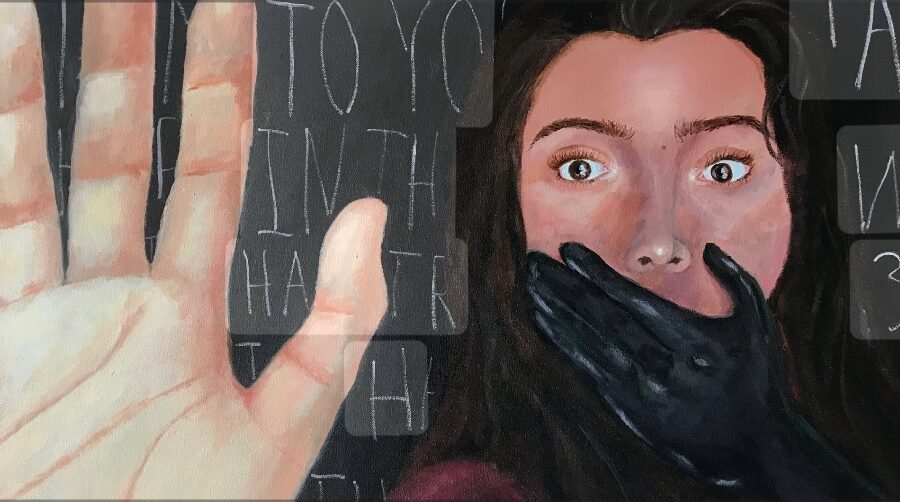
The Supreme Court sets aside an Allahabad High Court order that had diluted charges against two accused in a POCSO case, while simultaneously directing the National Judicial Academy to frame sensitivity guidelines for handling sexual offence cases.
Background: How the Case Reached the Supreme Court
The matter originated from Complaint Case No. 23/2022, where a minor girl was allegedly lured by two accused persons who promised to drop her home, but instead took her to a secluded spot near a culvert on their motorcycle, where they committed sexually offensive acts upon her. Due to her cries, two witnesses arrived at the scene, forcing the accused to flee.
The Special Judge (POCSO), Kasganj, had issued summons on 26.03.2023 under Section 376 IPC (rape) read with Section 18 of the POCSO Act (attempt to commit an offence). In Criminal Revision No. 1449/2024, a single judge of the Allahabad High Court modified these summonses on 17.03.2025, downgrading the charge to the lesser Section 354B IPC (assault with intent to outrage modesty) read with Sections 9 and 10 of the POCSO Act — on the reasoning that the accused had only “prepared” to commit rape and had not “attempted” it.
The order drew sharp criticism from the organisation. We the Women of India, led by its Founder President Ms. Shobha Gupta, Senior Advocate, who wrote to the Chief Justice of India describing the High Court’s observations as erroneous in law, insensitive, and demoralising. This prompted registration of a Suo Motu Writ Petition (Criminal) No. 1/2025. Two further petitions — Diary Nos. 15692/2025 (by a Delhi NGO and the complainant-mother) and 21813/2025 (by a Kolkata NGO) — were also filed challenging the same High Court order.
The Core Legal Question: Preparation or Attempt?
The entire controversy centred on the distinction between “preparation” and “attempt” under criminal law — a distinction that determines whether a lighter or graver charge is attracted. The Supreme Court, per Surya Kant CJI, referred to its earlier two-Judge bench judgment in State of Madhya Pradesh v. Mahendra alias Golu, (2022) 12 SCC 442, which cogently sets out this distinction:
“The stage of ‘preparation’ consists of deliberation, devising or arranging the means or measures, which would be necessary for the commission of the offence. Whereas, an ‘attempt’ to commit the offence, starts immediately after the completion of preparation. ‘Attempt’ is the execution of mens rea after preparation. ‘Attempt’ starts where ‘preparation’ comes to an end, though it falls short of actual commission of the crime.”
Applying this settled principle to the facts, the Supreme Court found that the accused persons had plainly crossed the threshold of preparation. The pre-meditated deception to lure the victim, the act of stopping the motorcycle at an isolated location, and the commission of sexually offensive acts upon her — all recorded by the High Court itself — cumulatively demonstrated that the mens rea had already been set into execution. The only reason the rape was not completed was the fortuitous intervention of third-party witnesses. This is a well-recognised touchstone in attempt jurisprudence: an act does not cease to be an attempt merely because it is interrupted by extraneous circumstances beyond the accused’s control.
The High Court’s Error and the Supreme Court’s Correction
The Allahabad High Court had concluded, on a prima facie assessment, that the facts did not disclose an attempt to commit rape. The Supreme Court rejected this conclusion as a “patently erroneous application of the settled principles of criminal jurisprudence.” The observations of the High Court in paragraphs 21, 24, and 26 of the impugned order — which drew criticism for being insensitive — were first stayed by the Supreme Court on 26.03.2025, with the entire judgment stayed on 08.12.2025. The trial was directed to proceed as if summons had been issued under Section 376 read with Section 511 IPC and Section 18 POCSO Act.
By its final judgment dated February 10, 2026, the Supreme Court set aside the impugned High Court judgment in its entirety and restored the original summons order of 26.03.2023 passed by the Special Judge (POCSO), Kasganj. The Criminal Appeals arising out of Diary Nos. 15692 and 21813/2025 were accordingly allowed. The Court was careful to clarify that its findings are only at the prima facie level and shall not be construed as any opinion on the guilt of the accused, which remains to be determined in the ongoing trial.
The Broader Direction: Judicial Sensitivity in Sexual Offence Cases
Beyond the immediate legal correction, the Supreme Court engaged with the systemic concern raised by the petitioners — that judges at various levels of the judiciary have frequently failed to bring adequate compassion and empathy to cases involving sexual offences, particularly those involving vulnerable or minor victims. The Court acknowledged that earlier efforts by Constitutional Courts, both on the judicial and administrative side, have not yielded the expected results.
Accordingly, the Supreme Court directed the National Judicial Academy (NJA), Bhopal, through its Director, Justice Aniruddha Bose (former Judge of the Supreme Court), to constitute a Committee of Experts within two weeks. Justice Bose was requested to chair the Committee, which shall include four domain experts drawn from among practitioners, academicians, and social workers.
The Committee has been tasked with preparing a comprehensive report titled “Developing Guidelines to Inculcate Sensitivity and Compassion into Judges and Judicial Processes in the Context of Sexual Offences and other Vulnerable Cases.” The report must include draft guidelines for the approach of judges and the judicial system when dealing with cases of sexual offences and similarly sensitive matters involving vulnerable victims, complainants, and witnesses. It must also review previous measures and their on-ground outcomes.
A particularly noteworthy direction is for the Committee to identify and compile offensive words and expressions used in local dialects across India’s diverse linguistic landscape — terms that complainants and victims may use to describe their trauma but which may go unrecognized or under-recorded due to linguistic unfamiliarity. The guidelines themselves are required to be drafted in simple language comprehensible to laypersons, with translated versions of public-facing sections where necessary. The Committee may seek assistance from linguists, prosecutors, social scientists, and counsellors. A report is to be submitted preferably within three months, and upon receipt, the Supreme Court Registry shall place it before the Chief Justice for appropriate directions.
Significance of the Judgment
This judgment is significant on two counts. First, it reinforces the legally settled boundary between preparation and attempt in cases of sexual offences — a boundary that must not be blurred to the detriment of victims. The fact that the crime was not completed due to third-party intervention cannot, and should not, shield the accused from a charge of attempt to commit rape. The Supreme Court’s swift suo motu intervention also signals its willingness to correct High Court orders that dilute protective provisions in POCSO and IPC cases.
Second, the direction to the NJA to frame sensitivity guidelines marks an important institutional step. For long, judicial insensitivity in sexual offence cases has been critiqued by women’s rights advocates and legal scholars alike. Guidelines framed on the basis of expert deliberation, ground-level experience, and linguistic research could meaningfully improve the quality of judicial proceedings in these cases — both for the victims who approach courts and for the public trust that the justice system depends upon.
The judgment, authored by the Chief Justice himself and decided by a three-judge bench, thus combines immediate legal relief with a forward-looking institutional reform — making it one of the more consequential rulings in the domain of sexual offences and child protection in recent times.
Contributed by Vinay Kumar Advocate