
Introduction
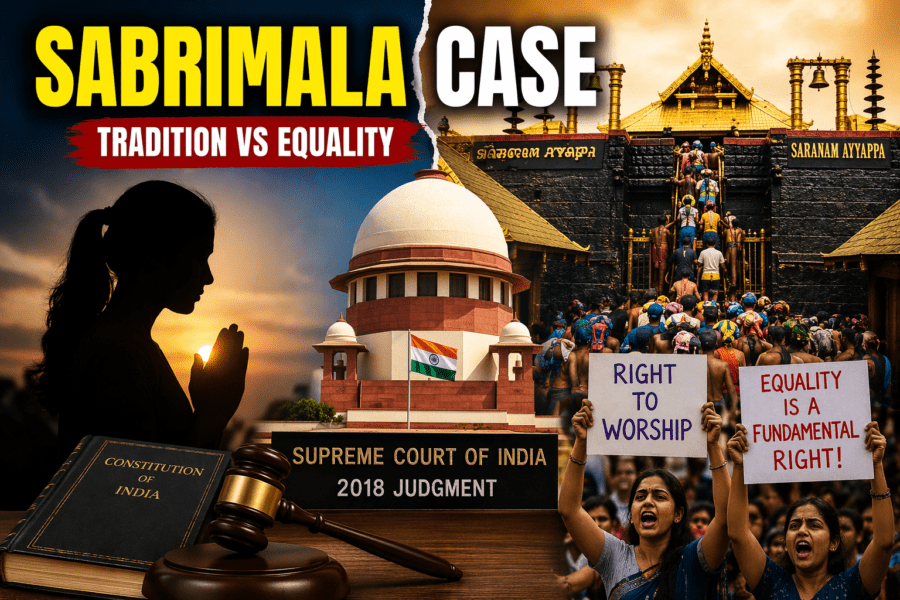
The Sabarimala Temple, dedicated to Lord Ayyappa, is one of the most prominent pilgrimage sites in India. Known for its strict customs and deep-rooted traditions, the temple became the center of a historic constitutional debate in India. The controversy revolved around the restriction on the entry of women of menstruating age (10–50 years), leading to a landmark judgment by the Supreme Court of India in 2018.
The Sabarimala case represents a critical intersection of fundamental rights, gender equality, religious freedom, and constitutional morality. It raised profound questions about the role of courts in reforming religious practices in a secular democracy.
Historical Background of the Practice
The restriction on women’s entry into Sabarimala is linked to the belief that Lord Ayyappa is a Naishtika Brahmachari (eternal celibate). Devotees argue that the presence of women of reproductive age would violate the celibacy of the deity.
The temple has traditionally barred women between the ages of 10 and 50, considering this age group to be biologically capable of menstruation. This practice was reinforced by Rule 3(b) of the Kerala Hindu Places of Public Worship (Authorization of Entry) Rules, 1965, which permitted exclusion based on custom.
For decades, the practice remained largely unchallenged until the issue was brought before the judiciary, questioning whether such exclusion violated constitutional guarantees.
Legal Journey of the Case
The legal battle began when a petition was filed by the Indian Young Lawyers Association in 2006. The petition challenged the constitutional validity of the ban on women’s entry, arguing that it violated fundamental rights under Articles 14, 15, 17, and 25 of the Constitution.
The case eventually reached a Constitution Bench of the Supreme Court of India, comprising five judges, including then Chief Justice Dipak Misra.
Key Constitutional Issues Involved
The Sabarimala case raised several constitutional questions:
1. Right to Equality (Article 14)
The exclusion of women based on biological factors was argued to be discriminatory and violative of equality before law.
2. Prohibition of Discrimination (Article 15)
Article 15 prohibits discrimination on grounds of sex. The ban on women’s entry was seen as a direct violation of this provision.
3. Abolition of Untouchability (Article 17)
Some petitioners argued that exclusion based on menstruation amounted to a form of “untouchability,” although this interpretation was debated.
4. Freedom of Religion (Article 25)
The respondents contended that the practice was an essential religious practice protected under Article 25, which guarantees freedom of religion.
The 2018 Judgment
In a 4:1 majority judgment delivered on September 28, 2018, the Supreme Court of India ruled in favor of allowing women of all ages to enter the Sabarimala Temple.
Majority Opinion
The majority held that:
- The exclusion of women violated Articles 14 and 15.
- The practice was not an essential religious practice.
- Devotion cannot be subjected to gender discrimination.
- Constitutional morality must prevail over social or religious norms.
Justice D.Y. Chandrachud emphasized that the ban stigmatized women and reinforced patriarchal notions of purity.
The Court also observed that religion cannot be used as a cover to deny fundamental rights.
Dissenting Opinion
Justice Indu Malhotra delivered the sole dissenting judgment. She argued that:
- Courts should not interfere in matters of deep religious faith.
- The determination of essential religious practices should be left to the religious community.
- Not all discrimination amounts to unconstitutional behavior, especially in religious contexts.
Her dissent highlighted the importance of judicial restraint in religious matters.
Concept of Essential Religious Practices
A central doctrine in the case was the “essential religious practices” test. The Court had to determine whether the exclusion of women was essential to the Ayyappa faith.
The majority held that the practice was not essential, as it was not fundamental to the religion itself. This interpretation allowed the Court to strike down the restriction.
However, critics argue that the judiciary lacks the theological expertise to decide what constitutes an essential religious practice, making this doctrine controversial.
Aftermath and Review Petitions
The 2018 judgment triggered widespread protests, particularly in Kerala. Many devotees opposed the ruling, viewing it as an intrusion into religious traditions.
Numerous review petitions were filed, leading the Supreme Court of India to revisit the issue in 2019. The Court did not stay the original judgment but referred larger questions regarding the interplay between fundamental rights and religious freedom to a larger bench.
As of now, the legal position remains complex, with the matter still under judicial consideration in a broader constitutional context.
Constitutional Morality vs Popular Morality
One of the most significant contributions of the Sabarimala judgment is the emphasis on “constitutional morality.”
Constitutional morality refers to adherence to the values enshrined in the Constitution, such as liberty, equality, and dignity, even if they conflict with popular beliefs or traditions.
The Court held that constitutional morality must prevail over social morality. This principle has far-reaching implications for other social and religious issues in India.
Gender Justice and Feminist Perspectives
From a feminist standpoint, the Sabarimala case was seen as a major step toward gender equality.
The exclusion of women based on menstruation was criticized as reinforcing stereotypes about impurity and inferiority. The judgment challenged these notions and upheld women’s right to worship.
However, some feminist scholars argued that imposing entry rights may overlook the agency of women who support the tradition, highlighting the complexity of the issue.
Criticism of the Judgment
Despite being hailed as progressive, the judgment faced criticism:
- Judicial Overreach: Critics argue that the Court interfered in religious matters beyond its jurisdiction.
- Selective Reform: Questions were raised about why similar practices in other religions were not addressed.
- Practical Challenges: Implementation of the judgment led to law and order issues.
These criticisms reflect the tension between legal principles and social realities.
Broader Implications
The Sabarimala case has implications beyond the temple itself:
- It redefines the scope of religious freedom in India.
- It strengthens the principle of gender equality.
- It raises questions about the role of courts in social reform.
- It impacts other cases involving religious practices and fundamental rights.
The case is often compared with other landmark judgments that expanded individual rights against traditional norms.
Conclusion
The Sabarimala case stands as a landmark in Indian constitutional law. It highlights the ongoing struggle to balance tradition with modern constitutional values. While the Supreme Court of India upheld the principles of equality and dignity, the social and legal debates surrounding the case continue. Ultimately, the case underscores that the Constitution is a living document, evolving with changing societal values. The Sabarimala judgment is not just about temple entry it is about the kind of society India aspires to be: inclusive, equal, and rooted in constitutional morality.
Contributed By: Advocate Seema Choudhary