
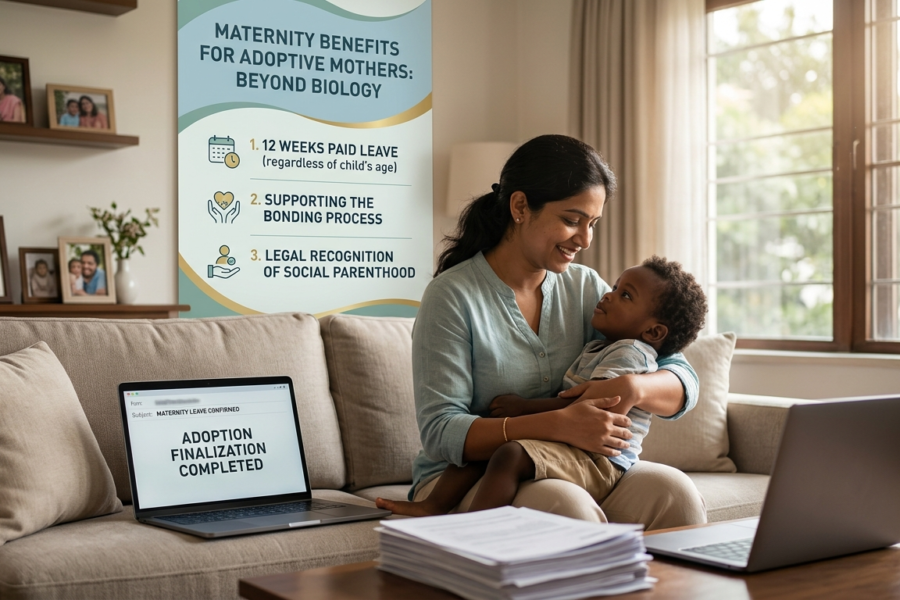
Beyond Biology: The Evolution of Maternity Benefits for Adoptive Mothers
For decades, the legal definition of motherhood was tethered strictly to biology. However, as modern society embraces diverse family structures, the law has had to sprint to keep pace. The journey of maternity benefits for adoptive mothers is a testament to this evolution—moving from complete exclusion to a hard-won recognition of parenthood as a social and emotional bond, rather than just a physiological one.
The Historical Gap: Biology as a Barrier
Historically, maternity leave was viewed solely through the lens of physical recovery from childbirth. Under the original Maternity Benefit Act of 1961, there was no mention of adoption. A woman who brought a child home through a legal adoption process was expected to return to her desk the next day, regardless of the child’s need for bonding or the parent’s need to navigate the complexities of a new family dynamic.
This exclusion created a “biological tax” on adoption. While biological mothers eventually received 26 weeks of paid leave to bond and recover, adoptive mothers were often forced to exhaust their personal annual leave or take unpaid time off, effectively penalizing them for their choice of reproductive autonomy.
The Legislative Shift: The 2017 Amendment
The first major crack in the biological wall came with the Maternity Benefit (Amendment) Act of 2017. This introduced, for the first time, a statutory right for “adoptive mothers” and “commissioning mothers” (surrogacy) to claim paid leave.
However, the benefit came with a significant—and highly controversial—caveat:
- Duration: 12 weeks of paid leave (compared to 26 weeks for biological mothers).
- The “Three-Month” Rule: The leave was only available if the child being adopted was below the age of three months.
The 2026 Landmark: Hamsaanandini Nanduri v. Union of India
The three-month restriction was widely criticized as “practically unworkable.” In India, the legal process of adoption—managed by CARA (Central Adoption Resource Authority)—is rigorous and time-consuming. Data indicated that less than 5% of children available for adoption were under three months old.
In a historic ruling on March 17, 2026, the Supreme Court of India struck down this age restriction. In the case of Hamsaanandini Nanduri v. Union of India, the Court held that:
- Constitutional Equality: Restricting benefits based on the child’s age violated Article 14 (Right to Equality). The Court noted that an older child often requires more intensive bonding and psychological support than a newborn.
- Reproductive Autonomy: Adoption was recognized as a fundamental expression of an individual’s reproductive choice under Article 21 (Right to Life and Dignity).
- De-familisation: The Court observed that maternity benefits act as an instrument of “de-familisation”—reducing a woman’s financial reliance on her family and protecting her economic independence during early motherhood.
Current Legal Status (as of 2026): All adoptive mothers are now entitled to 12 weeks of paid maternity leave, regardless of the age of the child at the time of adoption.
The Psychological Imperative: Why Leave Matters
The legal battle for these benefits wasn’t just about money; it was about the “Golden Hour” of bonding.
- Attachment Security: Adopted children, particularly those from institutional care, may face higher stress levels. The presence of a primary caregiver is essential to establish a “secure base”.
- Integration: It takes time for a child to adapt to a new environment, routine, and family structure. Maternity leave provides the stability required for this transition.
- Gender Parity: By supporting adoptive mothers, the law prevents them from being excluded from the workforce, ensuring that “motherhood does not become a factor for exclusion”.
Looking Ahead: The Call for Paternity Leave
The 2026 Supreme Court judgment did not stop at mothers. The Bench, led by Justice J.B. Pardiwala, urged the government to recognize paternity leave as a statutory social security benefit. The Court emphasized that “parenthood is not a solitary function” and that the absence of fathers during early childcare reinforces gender inequality and increases the burden on the mother.
Conclusion
The transition of maternity benefits from a biological recovery period to a social welfare right marks a sophisticated turn in global jurisprudence. By decoupling “motherhood” from “birth,” the law now protects the dignity of the adoptive family, ensuring that every child regardless of how they entered their home starts their new life with the undivided care and presence of their parent.
Contributed By: Advocate Seema Choudhary