
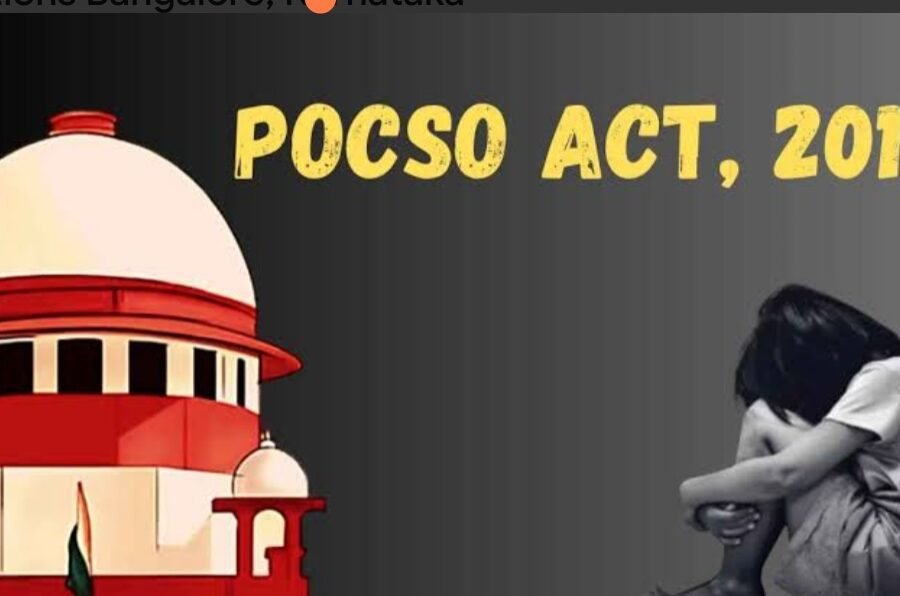
The Protection of Children from Sexual Offences Act 2012, remains India’s most robust legislative shield against child sexual abuse. Enacted to provide speedy justice, stringent punishment and child friendly procedures, the law was designed with the explicit intent of prioritizing the dignity, privacy and emotional wellbeing of minor victims. Yet, its implementation has often revealed a critical gap: judicial sensitivity. In a watershed development on 10th February 2026, the Supreme Court f India directly confronted this issue, setting aside an insensitive Allahabad High Court order and directing the framing of comprehensive guidelines to instill sensitivity and compassion in the adjudication of sexual offence cases, particularly those under the POCSO Act
The Trigger: An Insensitive High Court Observation
The case before the Supreme Court arose from allegations of an attempt to rape a minor girl. The trial court had framed charges under relevant provisions of the Indian Penal Code (IPC) for attempt to rape and under the POCSO Act. However, the Allahabad High Court, in its March 2025 order, took a strikingly narrow view. It observed that acts such as grabbing the minor victim’s breasts, breaking the string of her pyjama, and attempting to drag her beneath a culvert amounted only to “preparation” and not an “attempt to rape.” The High Court proceeded to dilute the charges and set aside the summons issued to the accused.
This reasoning was widely criticized for its mechanical, legalistic approach that appeared to trivialize the trauma inflicted on a child. The Supreme Court, in a strongly worded intervention, held that such acts clearly disclosed a prima facie case of “attempt” rather than mere preparation. A bench comprising Chief Justice of India Surya Kant and Justices Joymalya Bagchi and N.V. Anjaria restored the original trial court order and set aside the High Court’s dilution of charges.
Supreme Court’s Emphasis on Sensitivity and Compassion
The Supreme Court did not stop at correcting the legal error. It used the occasion to underscore a deeper systemic concern: the need for judges to approach POCSO and sexual offence cases with empathy, dignity, and victim-centric sensitivity. The Court acknowledged that judicial language, reasoning, and procedural handling can either heal or re-traumatize vulnerable victims—especially children.
In its order, the bench observed that sexual offence trials, particularly those involving minors, demand more than technical interpretation of law. They require an understanding of the psychological impact on victims, avoidance of humiliating or explicit descriptions in judgments, and a conscious effort to prevent secondary victimization. The Court noted that insensitive observations or orders not only undermine the protective intent of the POCSO Act but also erode public confidence in the justice system.
This was not an isolated rebuke. The judgment echoed earlier observations by the Supreme Court that POCSO cases warrant “prompt and sensitive handling.” In a January 2026 ruling revoking bail in a gang-rape POCSO matter involving video recording and threats, the Court had similarly stressed urgency and empathy in such cases.
Pathbreaking Direction: Guidelines for Judicial Sensitivity
Recognizing that the problem is systemic rather than episodic, the Supreme Court took a proactive step. It directed the National Judicial Academy (NJA), Bhopal, to constitute an expert committee chaired by its Director, Justice (Retd.) Aniruddha Bose (former Supreme Court judge), along with domain experts. The committee has been tasked with preparing a detailed report and drafting comprehensive guidelines titled “Draft Guidelines for the Approach of Judges and the Judicial System When Dealing with Cases of Sexual Offences and other Similarly Sensitive Occurrences Involving Vulnerable Victims, Complainants, and/or Witnesses.”
These guidelines are expected to address critical areas such as:
- Use of respectful, non-explicit, and non-humiliating language in judgments and court proceedings.
- Best practices for in-camera trials, support persons for victims, and child-friendly procedures under POCSO.
- Training on trauma-informed adjudication to avoid re-traumatization.
- Sensitivity towards linguistic diversity, disability access, and the cultural realities of victims from marginalized backgrounds.
- Ensuring consistency and compassion across trial courts, High Courts, and the Supreme Court.
The Court’s directive to the NJA marks a shift from ad-hoc corrections to institutional reform. It signals that judicial training must evolve beyond black-letter law to include emotional intelligence and victim psychology—qualities essential for upholding the spirit of the POCSO Act.
Broader Context: Balancing Sensitivity with Fairness
The February 2026 judgment arrives amid growing discourse on the POCSO Act’s application. In January 2026, the Supreme Court had flagged the misuse of the Act in consensual adolescent relationships and urged the Centre to consider a “Romeo-Juliet” clause for close-in-age exemptions. While that ruling addressed over-criminalization, the latest judgment focuses on the opposite end—ensuring that genuine cases of child sexual abuse are handled with the gravity and empathy they deserve, without diluting protections.
Together, these rulings reflect a maturing jurisprudence: one that protects children fiercely while demanding judicial maturity and humanity.
The Road Ahead: Transforming POCSO Implementation
The Supreme Court’s intervention is a timely reminder that laws like POCSO succeed not just through stringent provisions but through sensitive enforcement. Insensitive judicial remarks or orders can discourage reporting, deepen stigma, and defeat the Act’s core objective of creating a safe environment for children.
By mandating guidelines, the apex court has laid the foundation for a more empathetic judiciary. Legal experts, child rights organizations, and the legal fraternity have welcomed the move, viewing it as a long-overdue acknowledgement that justice for child victims must be both rigorous and restorative.
As the National Judicial Academy works on these guidelines, the message from the Supreme Court is clear: in POCSO cases, sensitivity is not optional—it is an essential component of justice. Only when judges internalize this principle can the POCSO Act truly fulfil its promise of protecting India’s children with dignity and compassion.
In the words of the evolving judicial philosophy, the courtroom must become a space of healing, not further harm. The February 2026 judgment is a significant stride in that direction.
Contributed By: Akshat Jain, advocate