
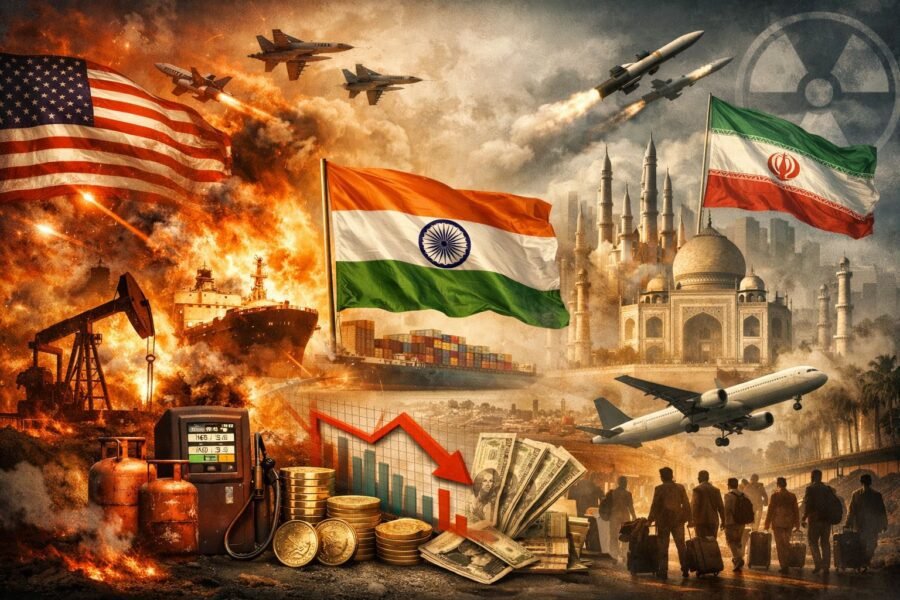
Introduction
The year 2026 has witnessed a dramatic escalation in tensions between the United States and Iran, culminating in a full-scale conflict that has reshaped global geopolitics. The war began on 28 February 2026, when the United States, along with Israel, launched coordinated airstrikes on Iranian nuclear and military installations, triggering retaliatory missile attacks and widespread regional instability.
This conflict has not remained confined to the Middle East. Given the strategic importance of the Persian Gulf in global energy supply and trade, its repercussions have rippled across continents. India, as one of the world’s fastest-growing economies and a major importer of energy, has been particularly vulnerable to these disruptions. The crisis has affected India’s economy, energy security, foreign policy, and even domestic socio-economic stability.
Background of the Conflict
The roots of the US–Iran conflict lie in longstanding tensions over Iran’s nuclear ambitions, regional influence, and ideological differences with the United States and its allies. The immediate trigger for the 2026 war was the breakdown of diplomatic negotiations and intelligence reports suggesting accelerated nuclear development by Iran.
The joint US-Israel strikes targeted key Iranian facilities and leadership, leading to a strong Iranian response involving missile attacks on US bases and energy infrastructure across the Gulf region.
A significant escalation occurred when Iran targeted energy facilities in Qatar, Kuwait, and Saudi Arabia, causing severe disruption to global oil supply chains. This not only intensified the conflict but also transformed it into a global economic crisis.
Global Economic and Energy Implications
One of the most immediate consequences of the conflict has been a surge in oil and gas prices. The Strait of Hormuz, through which a substantial portion of the world’s oil passes, became a focal point of tension. Iran’s actions in the region, including threats of blockades, disrupted global energy flows.
Oil prices surged beyond $100 per barrel and, at times, approached $120, triggering fears of a prolonged energy crisis. The International Energy Agency even described the situation as one of the most severe energy security challenges in modern history.
Global financial markets have reacted with volatility. While temporary pauses in hostilities have caused brief recoveries, investor confidence remains fragile due to uncertainty regarding the conflict’s duration.
Impact on India’s Energy Security
India is heavily dependent on imports for its energy needs, sourcing a significant portion of crude oil and liquefied petroleum gas (LPG) from the Gulf region. The disruption of supply routes, particularly through the Strait of Hormuz, has severely affected India.
Nearly 90% of India’s LPG imports pass through this strait, making it a critical vulnerability. The conflict has led to acute shortages of LPG, with reports of long queues, black market sales, and rationing across several parts of the country.
The government has been forced to prioritize household consumption over commercial use, while industries dependent on fuel have scaled down operations. This highlights India’s overdependence on West Asian energy supplies and the urgent need for diversification.
Economic Consequences for India
The war has had a profound impact on India’s macroeconomic stability. Rising oil prices have increased the country’s import bill, widened the current account deficit, and contributed to inflationary pressures.
The Indian rupee has come under significant stress, touching record lows against the US dollar due to capital outflows and rising import costs. Additionally, government bond yields have surged, reflecting market anxiety and reduced investor confidence.
Domestic economic activity has also slowed. Manufacturing growth has declined to a multi-year low, driven by increased input costs and weakened demand. At the same time, rising fuel prices have had a cascading effect on food, transportation, and essential commodities, thereby increasing the cost of living for ordinary citizens.
Impact on Trade and Supply Chains
India’s trade routes have been significantly affected due to instability in the Middle East. The closure or disruption of key shipping lanes has increased transportation costs and delayed shipments.
Industries dependent on imports, such as petrochemicals, fertilizers, and manufacturing, have faced supply shortages and increased costs. Additionally, disruptions in global logistics have affected exports, although some sectors have shown resilience due to increased global demand. The conflict has also exposed vulnerabilities in global supply chains, prompting calls for diversification and self-reliance under initiatives like “Atmanirbhar Bharat.”
Indian Diaspora and Remittances
The Gulf region hosts millions of Indian workers, whose remittances form a crucial part of India’s foreign exchange earnings. The conflict has placed these workers at risk, with many facing job losses, displacement, or forced evacuation.
Reports indicate large-scale repatriation of Indian nationals from the region, with over 200,000 returning due to escalating hostilities. This reverse migration has significant implications for India’s labour market and remittance inflows. A decline in remittances could further strain India’s external finances, especially at a time when the country is already grappling with a rising import bill.
Diplomatic Challenges and India’s Strategic Position
India has traditionally maintained a policy of strategic autonomy, balancing its relations with both the United States and Iran. The current conflict has tested this delicate balance. India has refrained from taking sides, instead calling for restraint and diplomatic resolution. At the same time, it has engaged with Gulf countries and other stakeholders to ensure the safety of its citizens and secure energy supplies.
However, this neutrality has not been without criticism. Domestically, political opposition has questioned the government’s stance, while internationally, India faces pressure to align more clearly with one side. The situation underscores the complexity of India’s foreign policy in an increasingly polarized world.
Social and Domestic Impacts
The effects of the conflict are not limited to macroeconomic indicators; they are deeply felt at the grassroots level. Rising fuel and LPG prices have directly impacted household budgets, particularly among lower-income groups. Shortages of cooking gas have forced many households to revert to traditional fuels, increasing health and environmental risks. Industries such as ceramics, hospitality, and transportation have faced disruptions, leading to job losses and reduced economic activity. The crisis has also triggered public protests and unrest in some regions, reflecting the socio-economic strain caused by the conflict.
Recent Developments and Ongoing Uncertainty
Recent developments indicate that the conflict remains fluid, with intermittent pauses and diplomatic signals suggesting the possibility of negotiations. However, mixed messages from both the US and Iran have created uncertainty about the prospects for peace.
Temporary de-escalation measures, such as pauses in military strikes, have provided short-term relief to global markets, but analysts warn that long-term stability remains elusive. The continuation of hostilities poses a persistent risk to global economic stability and India’s growth trajectory.
Way Forward: Policy Responses for India
In light of the ongoing crisis, India must adopt a multi-pronged strategy to mitigate risks and enhance resilience:
1.Energy Diversification-Reducing dependence on Middle Eastern oil by exploring alternative suppliers and investing in renewable energy.
2.Strategic Reserves-Expanding strategic petroleum reserves to cushion against supply shocks.
3.Diplomatic Engagement-Strengthening diplomatic efforts to promote peace and secure energy corridors.
4.Economic Reforms-Implementing policies to control inflation, stabilize currency, and support affected industries.
5.Diaspora Protection-Enhancing evacuation mechanisms and providing support to returning migrants.
Conclusion
The US–Iran conflict of 2026 represents a critical moment in global geopolitics, with far-reaching implications that extend well beyond the Middle East. For India, the crisis has exposed vulnerabilities in energy security, economic stability, and foreign policy.
While the country has demonstrated resilience in the face of these challenges, the situation underscores the need for long-term strategic planning and structural reforms. As the conflict continues to evolve, India’s ability to navigate these complexities will play a crucial role in shaping its future trajectory in an increasingly uncertain world.
The lessons from this crisis are clear: in an interconnected global order, regional conflicts can have profound domestic consequences, and preparedness is the key to resilience.
CONTRIBUTED BY: ARYAN POONIA